 DrawRabbit
Drawing guide · Dogs
How to draw a beagle begging
Biscuit has smelled sausages, and he’s sitting up as nicely as he knows how. In 69 steps you’ll draw a beagle begging at a market stall, his front paws up and his eyes on the sausages, using a pencil and paper: a few ovals and lines to start, then his long ear, his soft brown saddle and the stall behind him.
How do you draw a beagle begging?
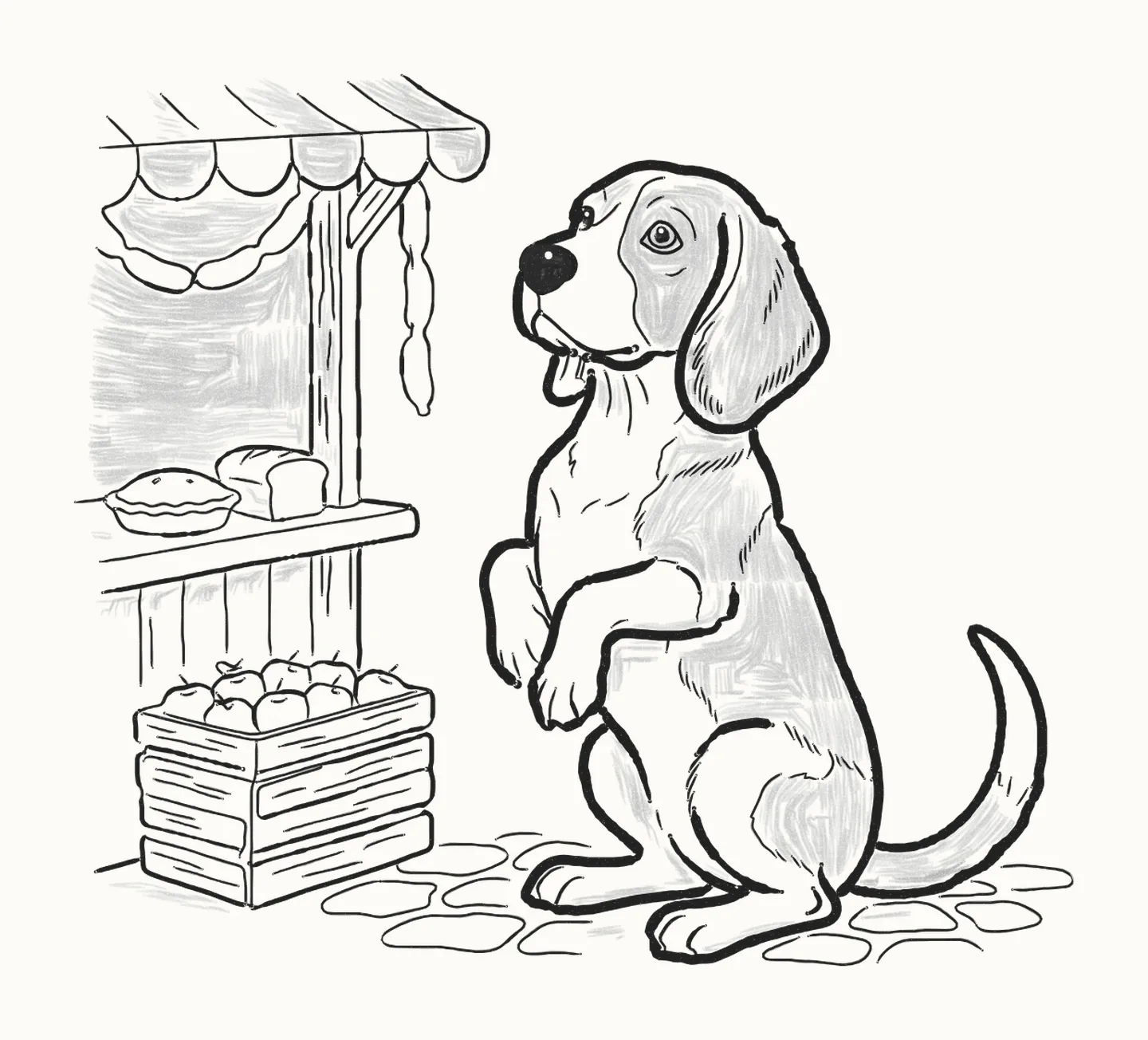
To draw a beagle begging, start light: an oval for his head, a tall oval leaning back under it for his body, a circle at its bottom right for his haunch, an oval behind his head for the ear, a line for the raised front leg and a curve for the tail. Draw his head in one curve over to the top of his muzzle, his long ear with its fold, his big nose, his muzzle and mouth, an almond eye on the right and just the dark iris of the eye on the left, then his brows and his cheek. Add the tip of his far ear under his chin, his chest and back, the front leg he holds up and the far one peeking out, his haunch, his back feet lying flat and his tail curling up. Then the fur: fine strokes in his ear and down his throat, a soft edge of short strokes for his brown saddle and the patch on his haunch, and four strokes where his tail turns white. Draw the stall: the striped awning with its flaps, a pie and a loaf on the counter, the post and its bracket, two drooping sausages and a string of them hanging, a crate of apples and the cobbles. Rub out the guides and go over Biscuit, leaving the stall light. Shade his head, ear, saddle, haunch and tail, keeping his chest, muzzle and the tip of his tail white, then give the stall a light tone. Last, fill in his nose and pupils. It takes 69 steps with a pencil, paper and an eraser.
You need a pencil, paper and an eraser69 stepsBeginner
Draw a beagle begging, step by step
In colour: what to draw nowGrey: already drawn
Draw everything in pencil, lightly at first. Save all 69 steps to Pinterest
-
Step 1 of 69Guide lines
Biscuit's guides
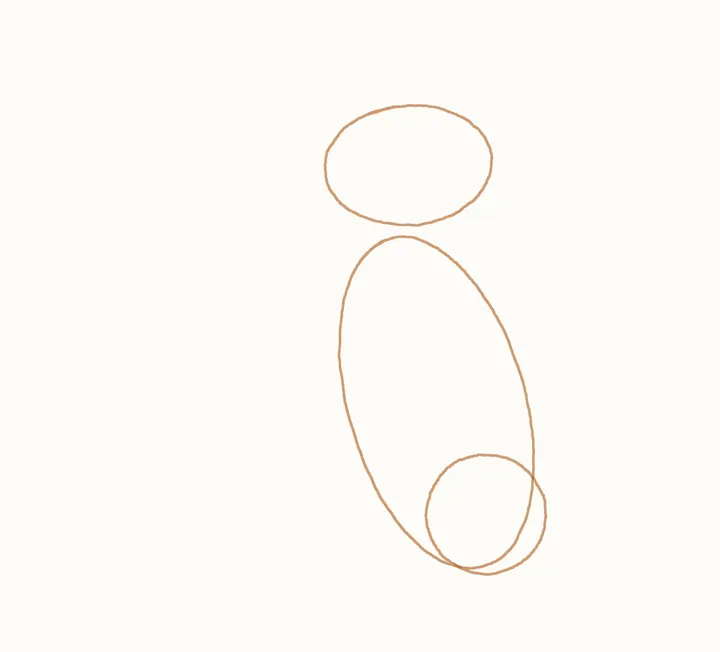
Biscuit begs at a sausage stall. Start light: an oval for his head, a tall oval leaning back under it for his body, and a circle out of its bottom right for the haunch.
Draw these lightly: they’re only there to help, and you’ll rub them out in step 47.
-
Step 2 of 69Guide lines
Biscuit's ear, leg and tail guides
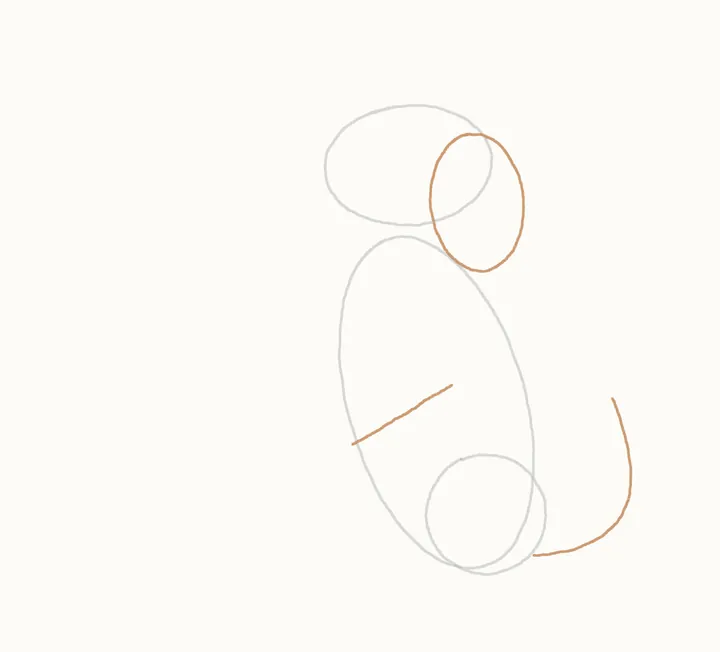
An oval behind his head for the ear. A line from the body's middle down past its left edge for the raised leg, and a curve from his rump up for the tail.
Draw these lightly: they’re only there to help, and you’ll rub them out in step 47.
-
Step 3 of 69
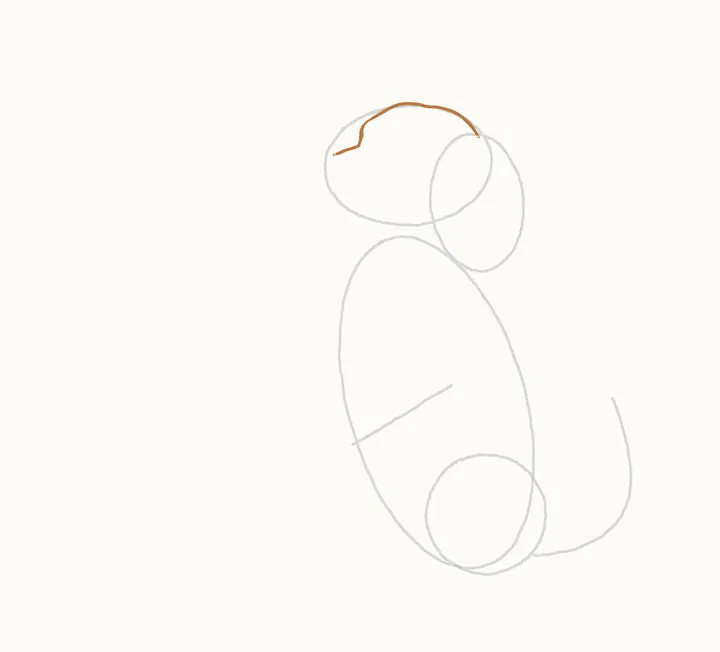
Biscuit's head
Now the real lines. From the top of the ear oval, one curve over his head, down into the dip between his eyes and along the top of his muzzle.
-
Step 4 of 69
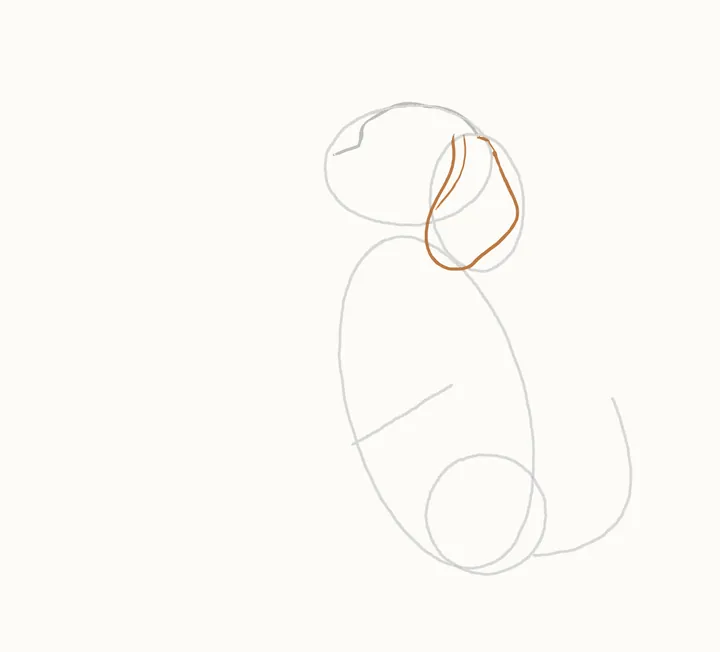
Biscuit's long ear
His long ear, over its oval: from his head, down its front, round the bottom, up the back to his head. Then one line inside for its fold, from the top down.
-
Step 5 of 69
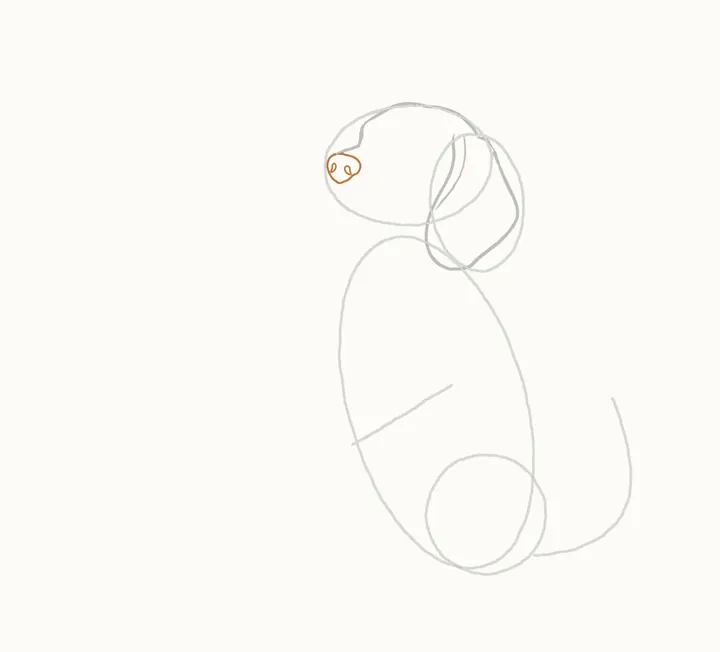
Biscuit's nose
At the tip of his muzzle, his big nose: one loop from its top, round the right and back up its front. Then a teardrop nostril at each side.
-
Step 6 of 69
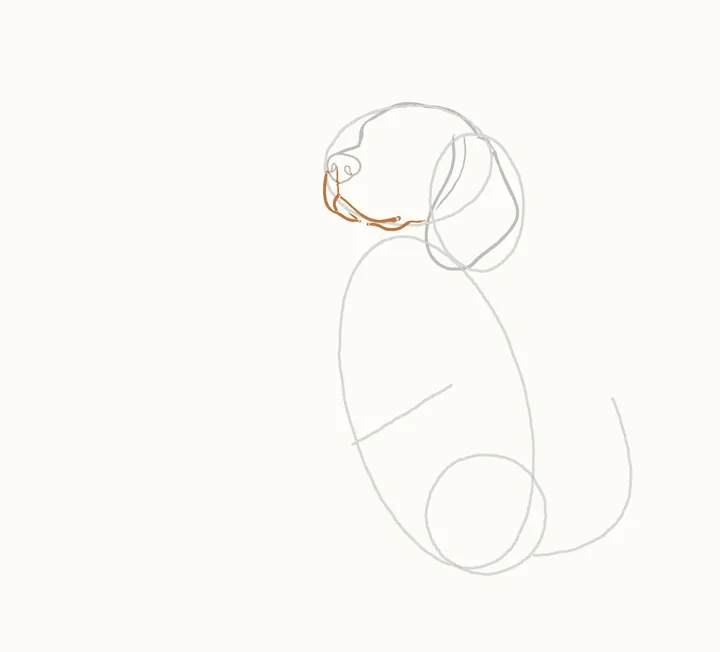
Biscuit's muzzle and mouth
From the nose, down round his lip to the chin, with a tick at its corner. Then a line from between the nostrils down, his mouth back to its dark corner, and his jaw.
-
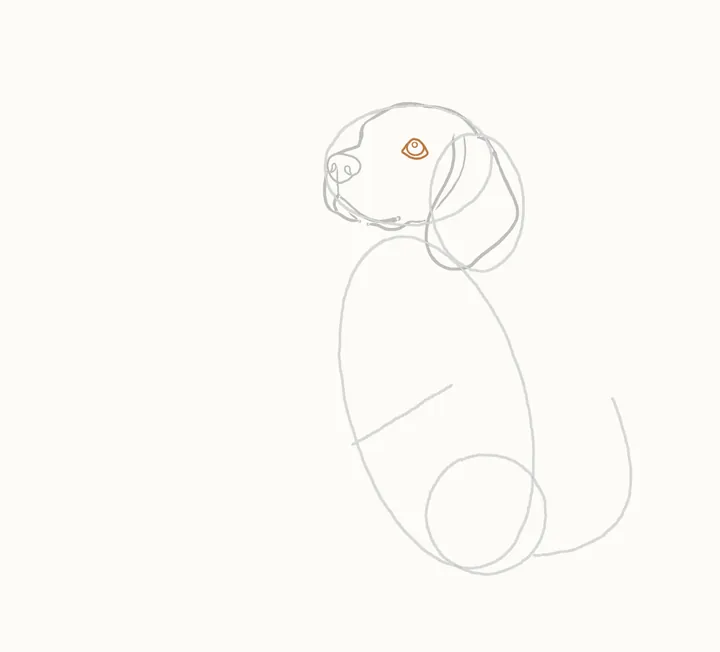
Step 7 of 69
Biscuit's eye on the right
His eye on the right, just above the middle of the head oval: an almond from its left corner. Then the iris, under the top lid, and a glint ring at its top.
-
Step 8 of 69
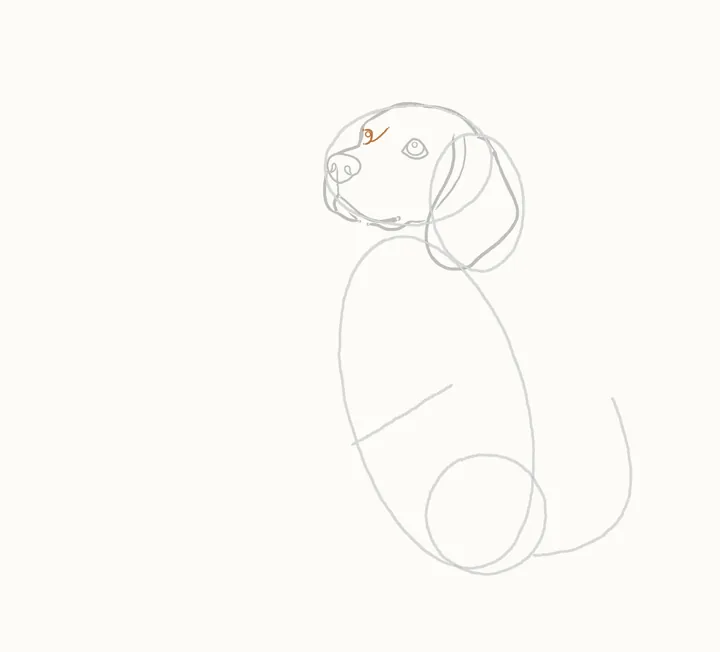
Biscuit's eye on the left
His other eye is just its dark iris: from the head line, one curve over and round its right side, back to it. A short line up from its corner, then a glint ring.
-
Step 9 of 69
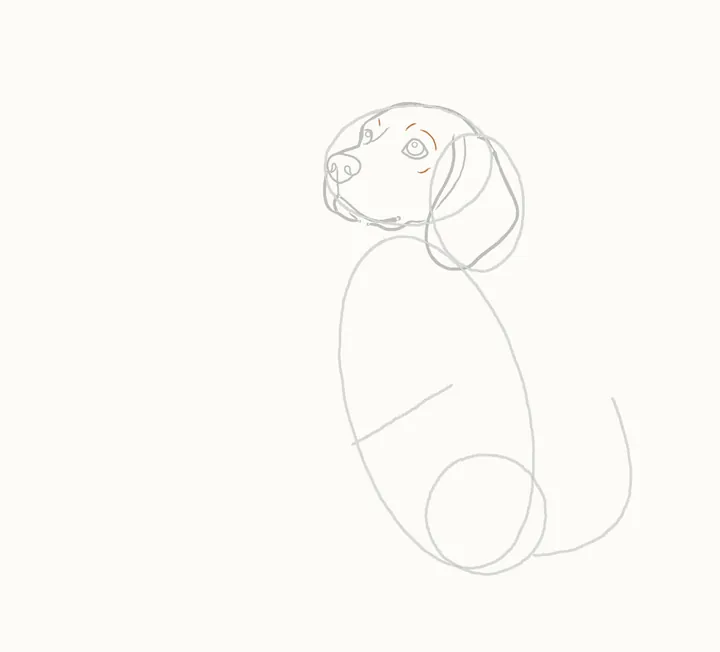
Biscuit's brows
By the eye on the right, a curve down past its top right corner and a short mark over it, and a dash under that eye. Then a tiny tick over the other eye.
-
Step 10 of 69
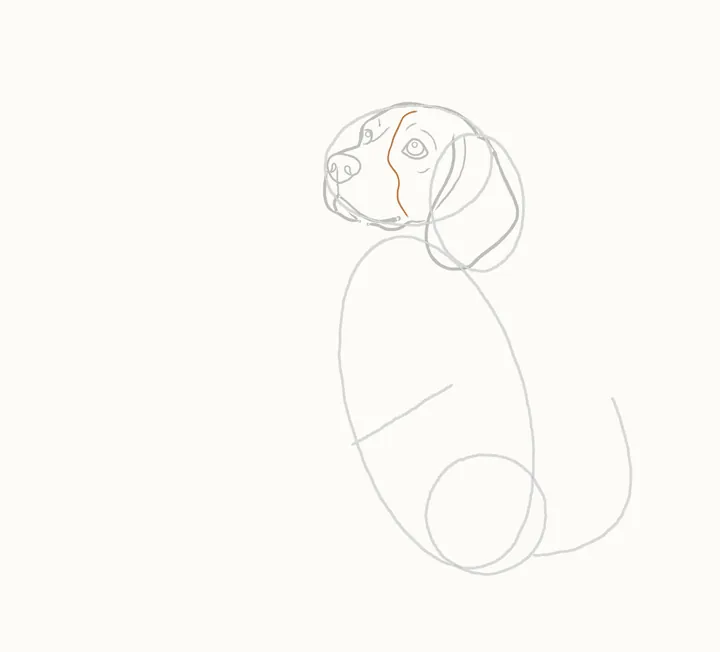
Biscuit's cheek
One long curve from the top of his head, down between his eyes to his mouth.
-
Step 11 of 69
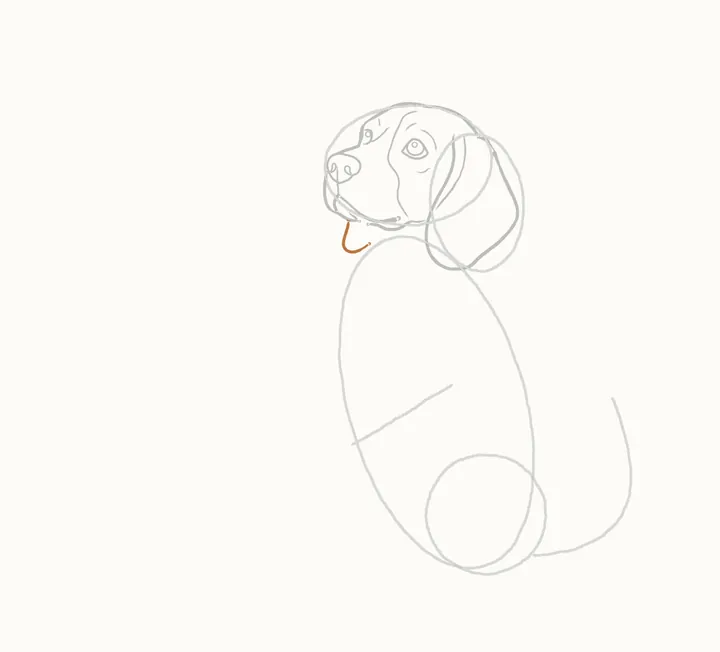
Biscuit's far ear
Under his chin, the tip of his other ear: from the chin, down round its rounded end and back up under the jaw.
-
Step 12 of 69
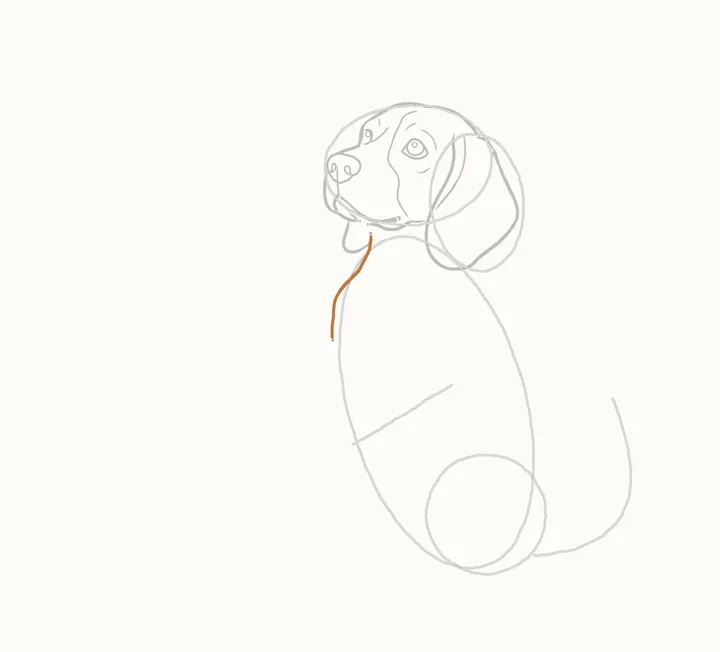
Biscuit's chest
From under the far ear, the front of his neck and chest: one line down just outside the left edge of the body oval, bulging out a little, to a third of the way down.
-
Step 13 of 69
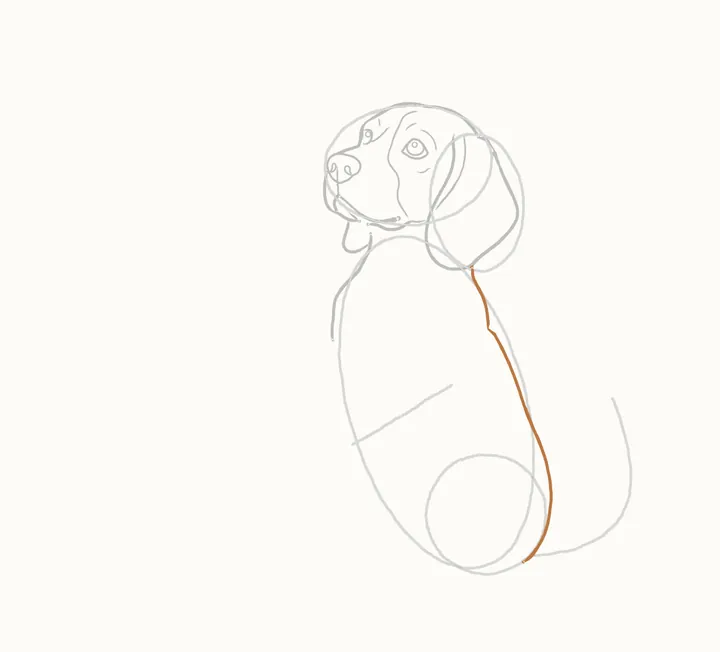
Biscuit's back
From under his long ear, one line down the back of his neck and his back, round the right of the body oval to the bottom of the haunch circle.
-
Step 14 of 69
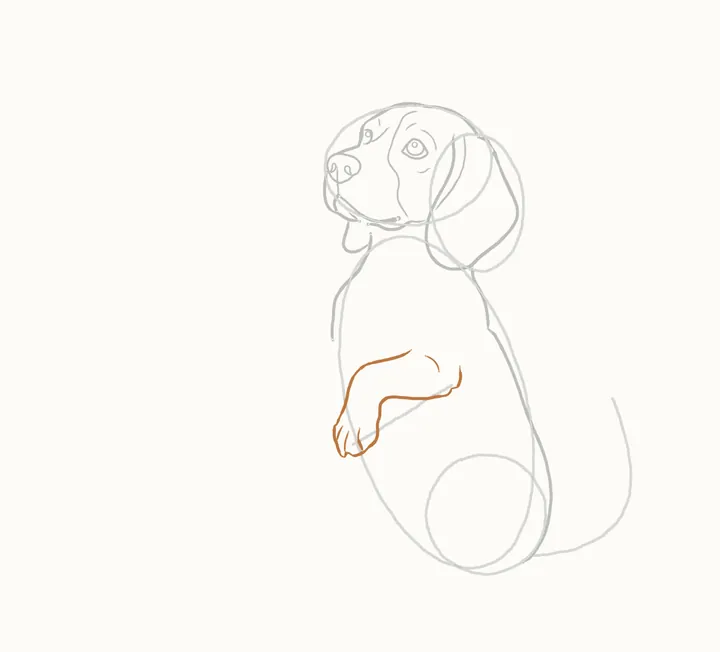
Biscuit's front leg nearest you
His raised front leg, on its line: from above the elbow, down round it, under to the paw, round the toes, up to his chest. Then three toe lines, and one at his chest.
-
Step 15 of 69
Biscuit's far front leg
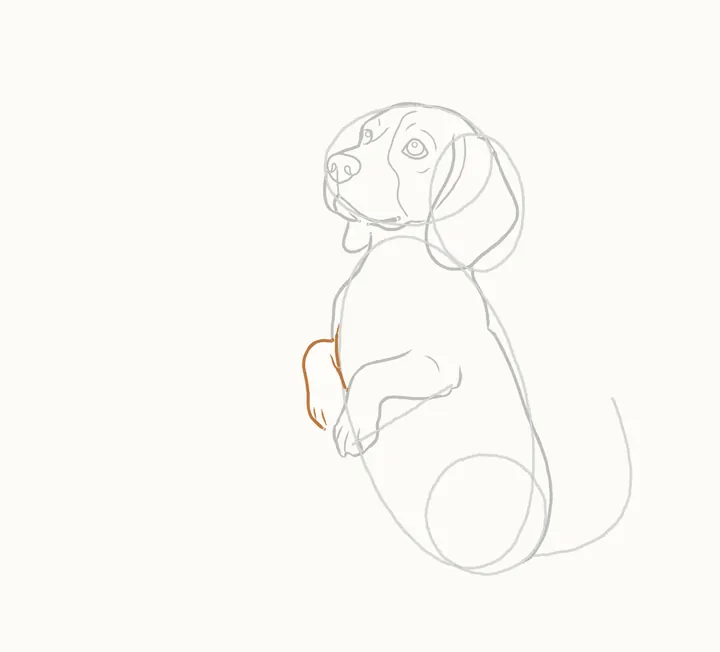
His other front leg peeks out on the left: from under the first paw, round its toes and up to his chest. Then two toe lines, two lines down its edge by the first leg.
-
Step 16 of 69
Biscuit's haunch
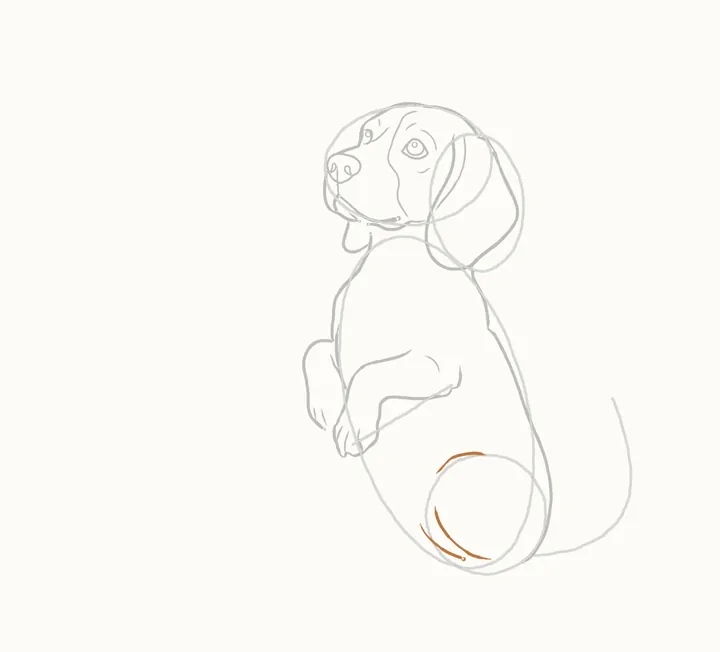
On the haunch circle: a curve over its top. Then two lines from low inside it, sloping down to the right, for the back leg folded under him.
-
Step 17 of 69
Biscuit's back foot nearest you
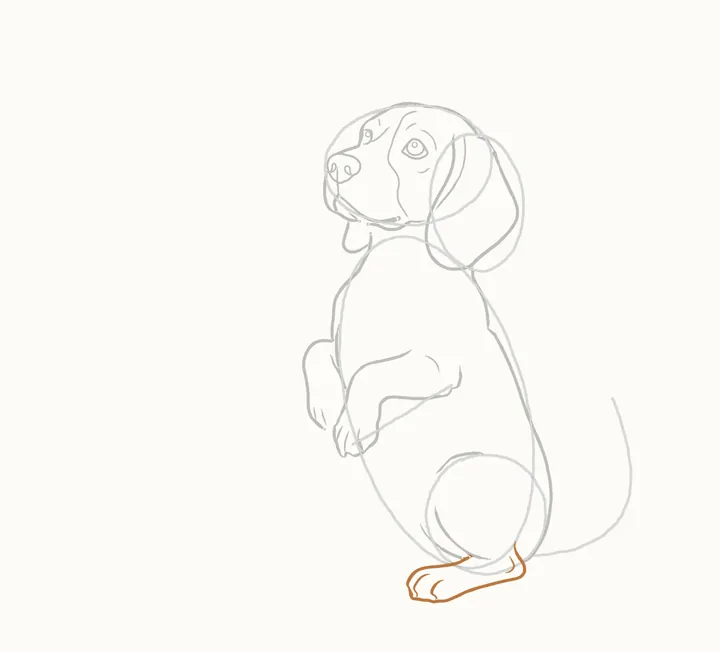
His back foot nearest you lies flat: from the heel, under the foot to its toes, then back along its top to the leg. A short line at the heel, two toe lines.
-
Step 18 of 69
Biscuit's far back leg
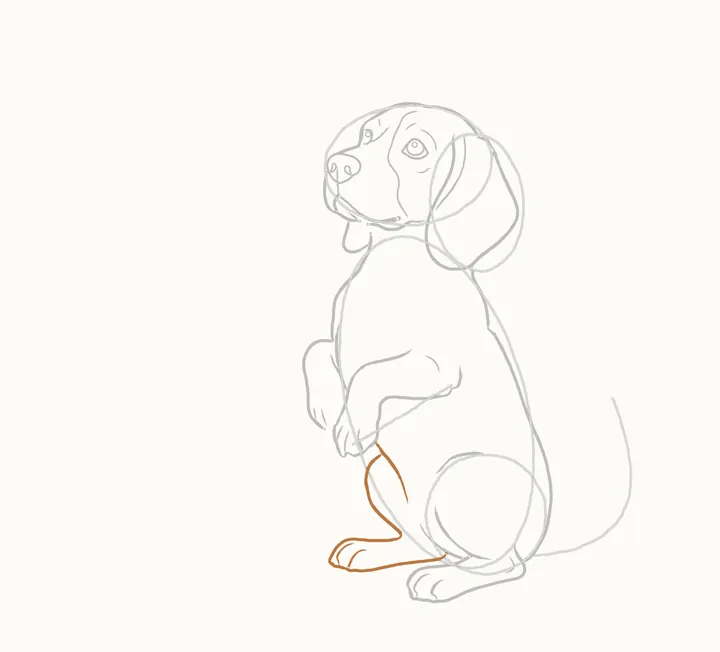
The far back leg: from beside the near foot, under the far foot, round its toes and up its front to his raised paws. Then a line down to the haunch, and two toe lines.
-
Step 19 of 69
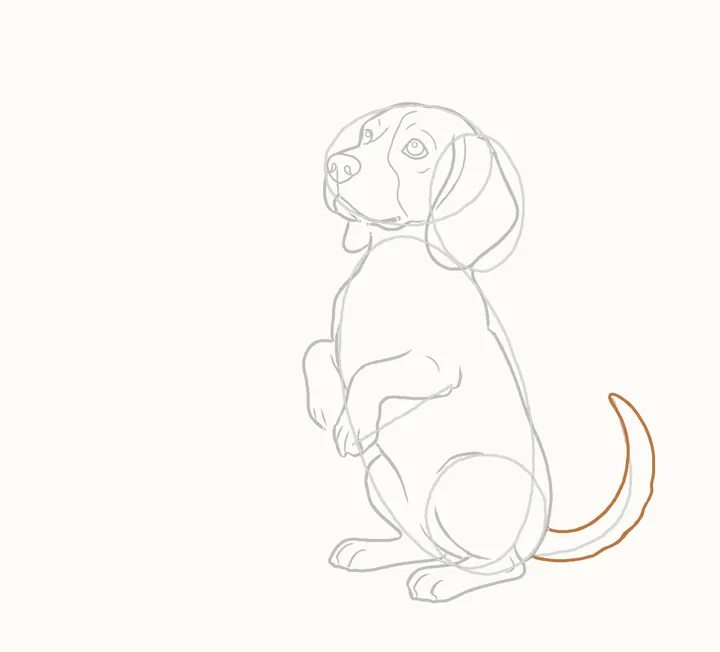
Biscuit's tail
His tail curls up along its guide: from his rump, out round the outside of the curve to the pointed tip, then back down the inside and along under to his rump.
-
Step 20 of 69
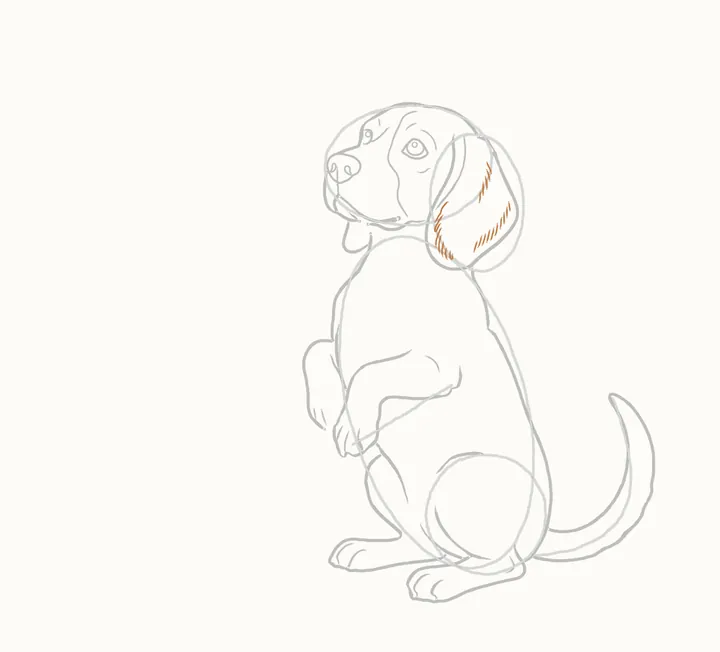
Fur on Biscuit's long ear
Fine fur in his long ear, each stroke from its top: seven down beside the fold, five down the middle of the ear, then ten along its back edge, top to bottom.
-
Step 21 of 69
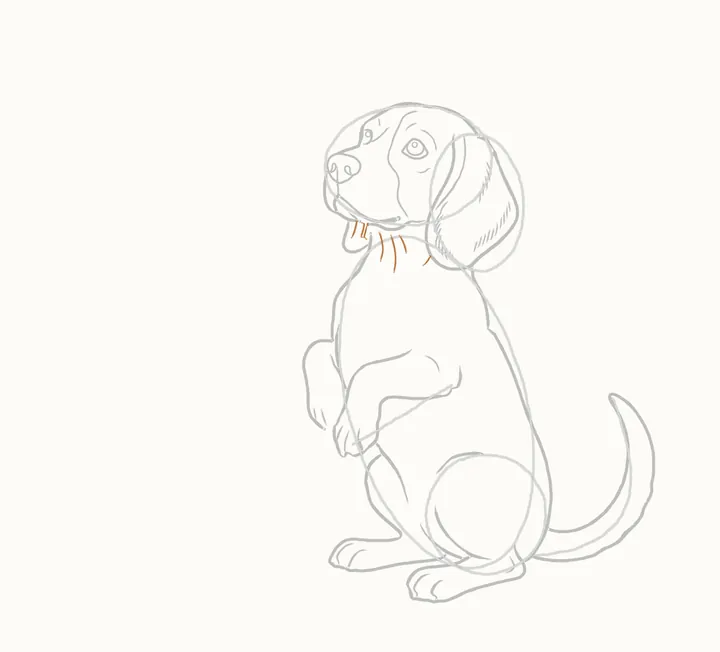
Fur under Biscuit's chin
Under his chin, three short strokes in the tip of his far ear, left to right. Then fine fur lines down his throat: four of them, left to right, the first two long.
-
Step 22 of 69
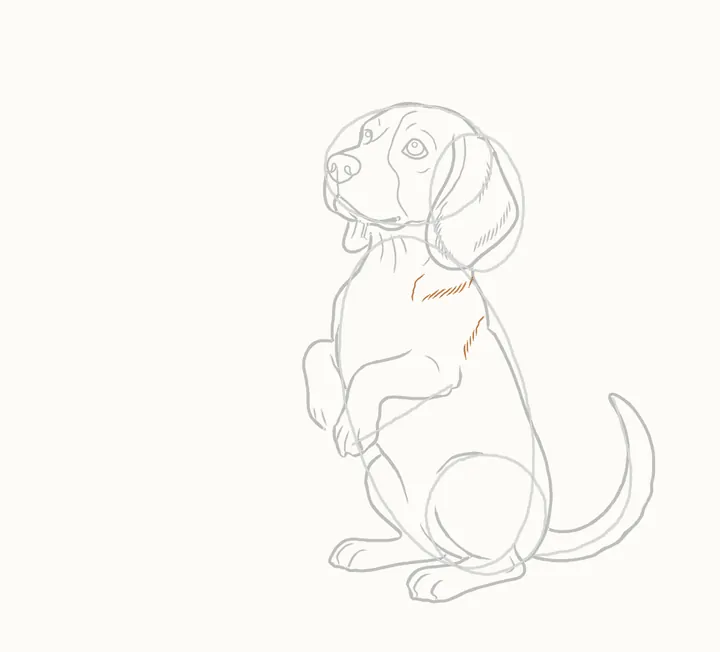
The edge of Biscuit's saddle
His brown saddle has a soft edge of short strokes: eight from under his long ear along to the left, then a longer one down. Then lower, just inside his back line, five more down.
-
Step 23 of 69
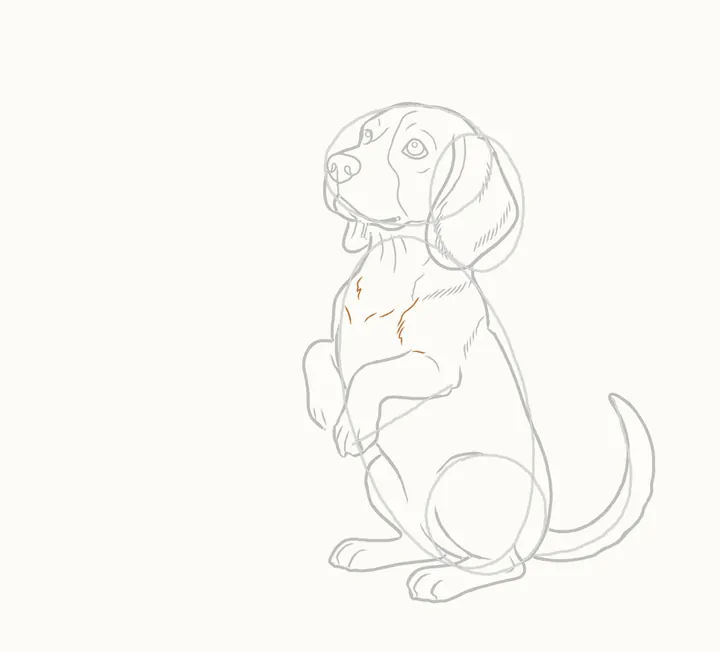
Fur on Biscuit's chest
Fur on his chest: two strokes down its front edge, from the top. Then two lines across its middle from the left, three strokes to the right of them, and one above the raised leg.
-
Step 24 of 69
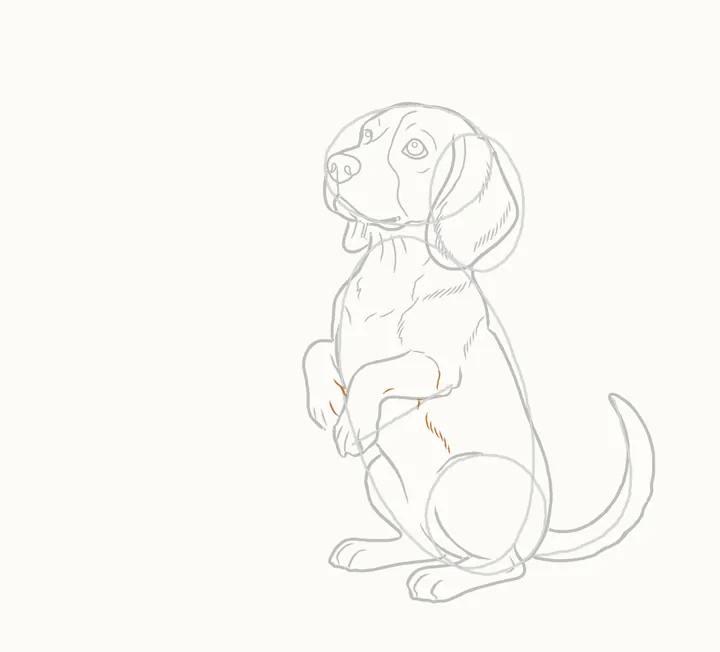
Fur on Biscuit's legs
Short fur strokes on his front legs: two on the far paw, one on the near leg. Then eight down his belly behind the leg, from the elbow to the haunch.
-
Step 25 of 69
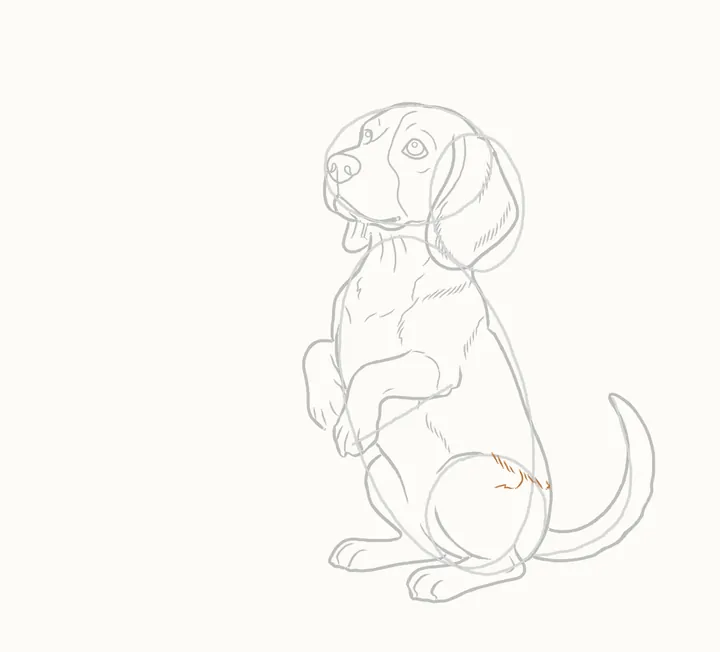
Biscuit's thigh patch
The same soft edge on his haunch: nine short strokes down the upper right of the haunch circle, along its edge, and one line under them on the left.
-
Step 26 of 69
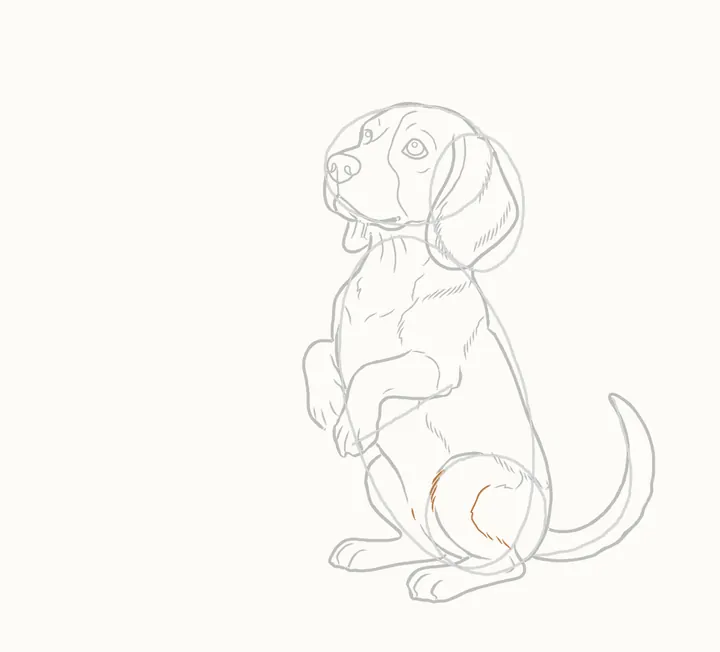
Fur on Biscuit's haunch
Down the front of his haunch, four short strokes for a soft edge, and one more to their left. Then one curve down inside the haunch, and three short strokes to the folded leg.
-
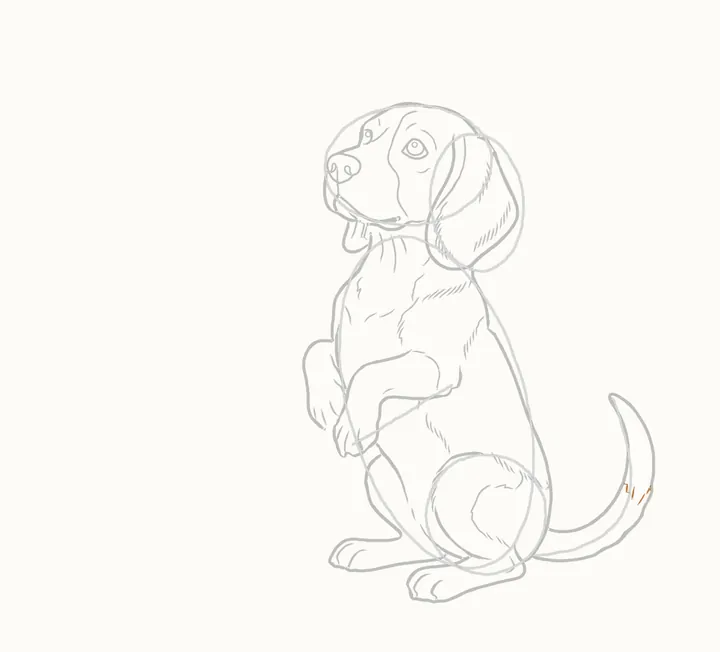
Step 27 of 69
Where Biscuit's tail turns white
About halfway up his tail, where the brown ends and the white tip begins: four short strokes across it, left to right.
-
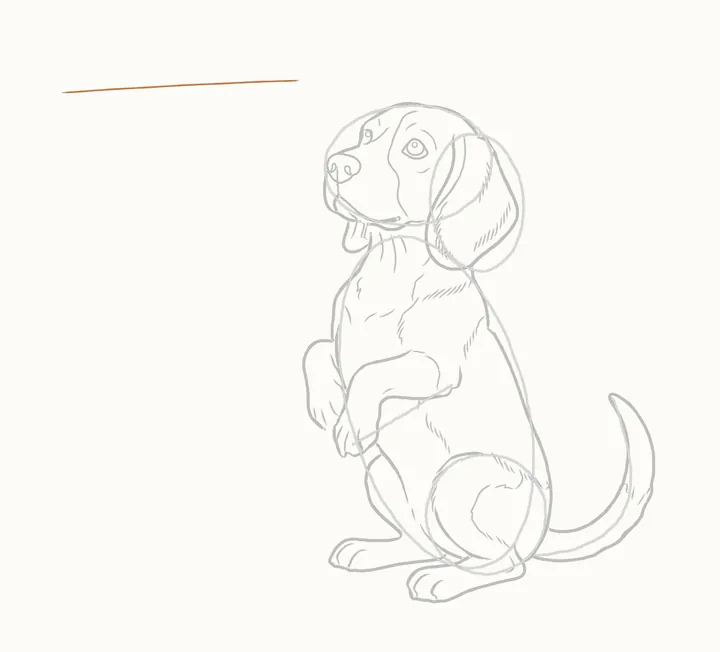
Step 28 of 69
The awning's rail
Now the stall: the awning's rail, from just short of Biscuit's nose and a little higher than his head, leftwards about half as far as he is tall.
-
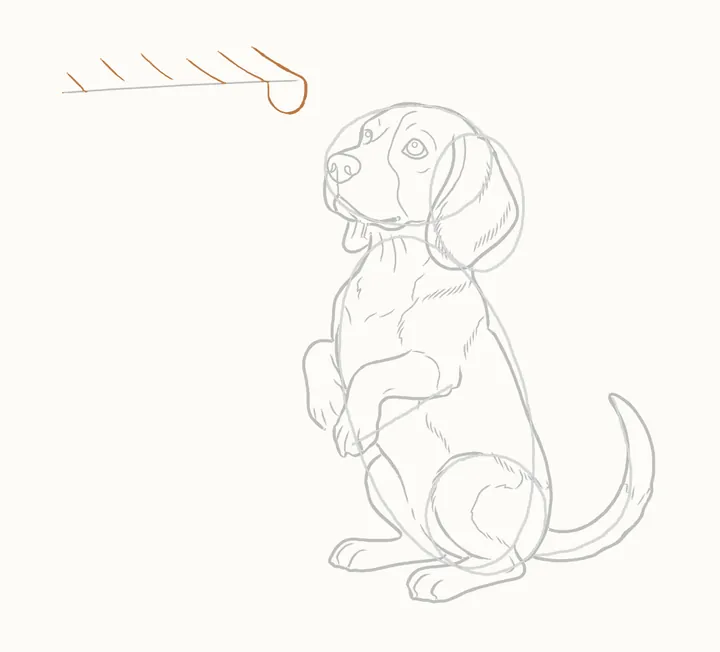
Step 29 of 69
The awning's stripes
Five stripes slant up from the rail, left to right. Then a loop down round its right end that runs on up as the last stripe.
-
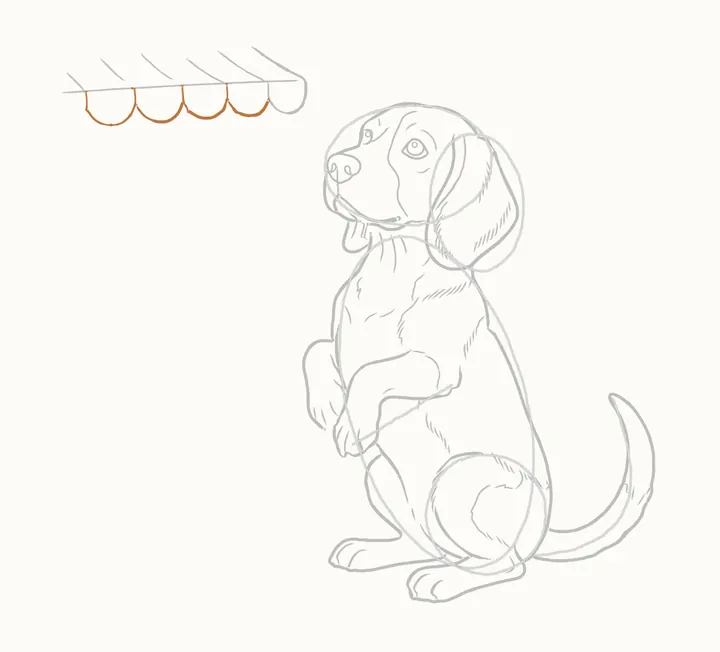
Step 30 of 69
The awning's flaps
Under the rail, the awning's wavy edge: four rounded flaps, left to right, each one curve from the rail down and back up.
-
Step 31 of 69
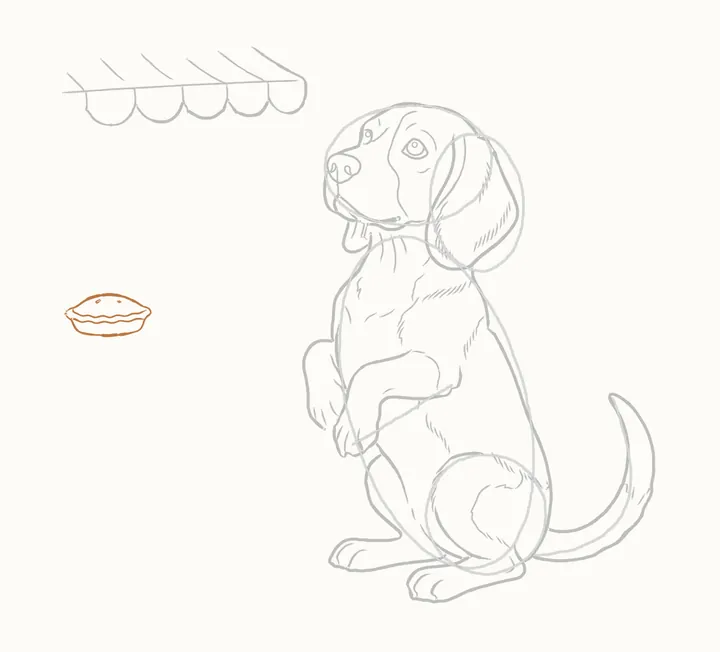
The pie
Well below the first flap, a pie, its bottom level with the end of his chest line: its outline, then two wavy lines across it for the crimped edge, and two little marks on top.
-
Step 32 of 69
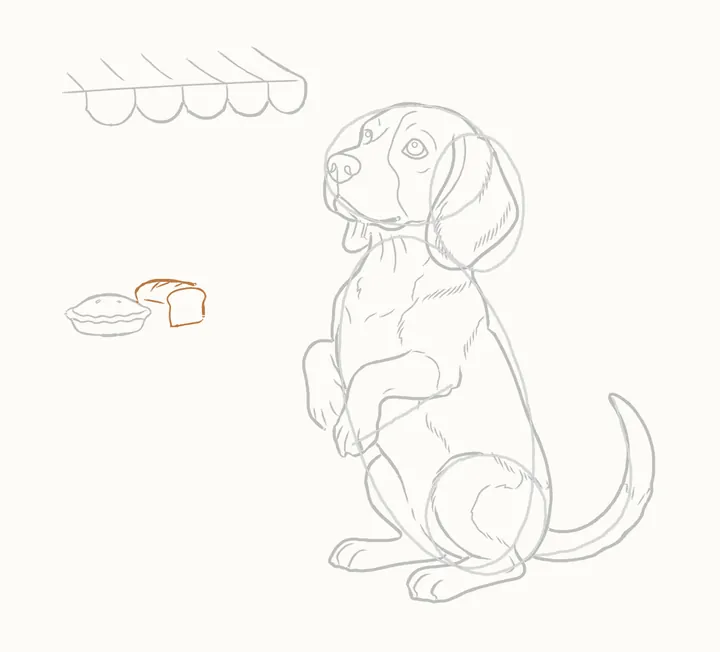
The loaf
Beside it a loaf: its rounded back, its cut end facing you, a line on its side, then three slashes on top.
-
Step 33 of 69
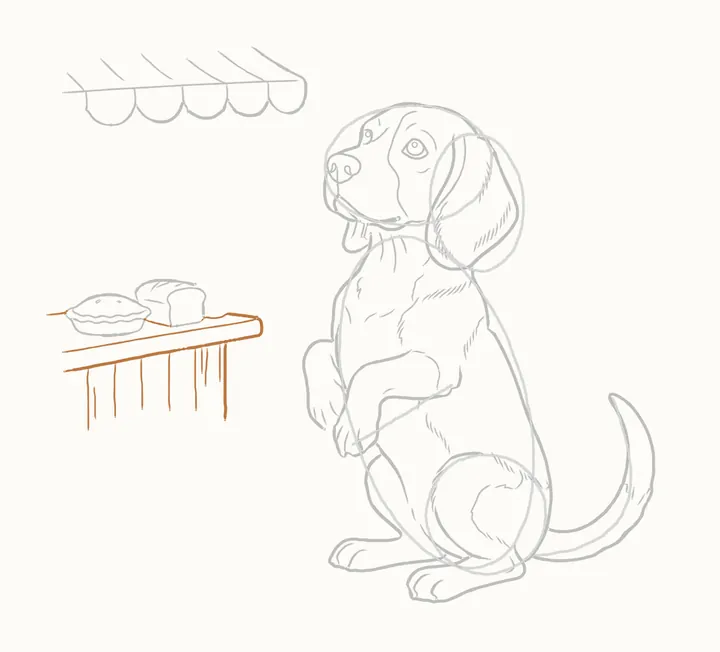
The counter
They sit on the counter: its back edge in three short pieces, left to right. Its front edge from the right, then from there round its thick end and under it, and ten boards below.
-
Step 34 of 69
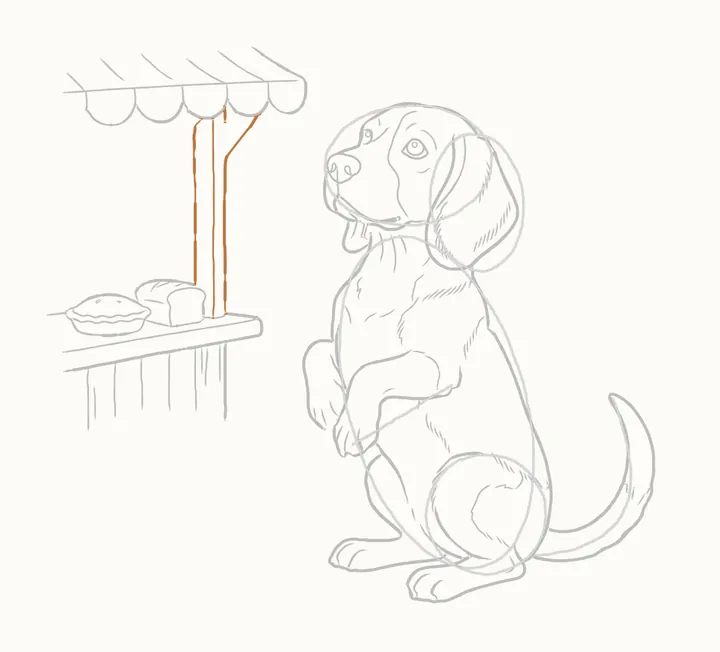
The post
The post: its left edge from the loaf to the flaps, a line beside it to the counter. Its right side goes up, bending out at the top, then a short line above the bend.
-
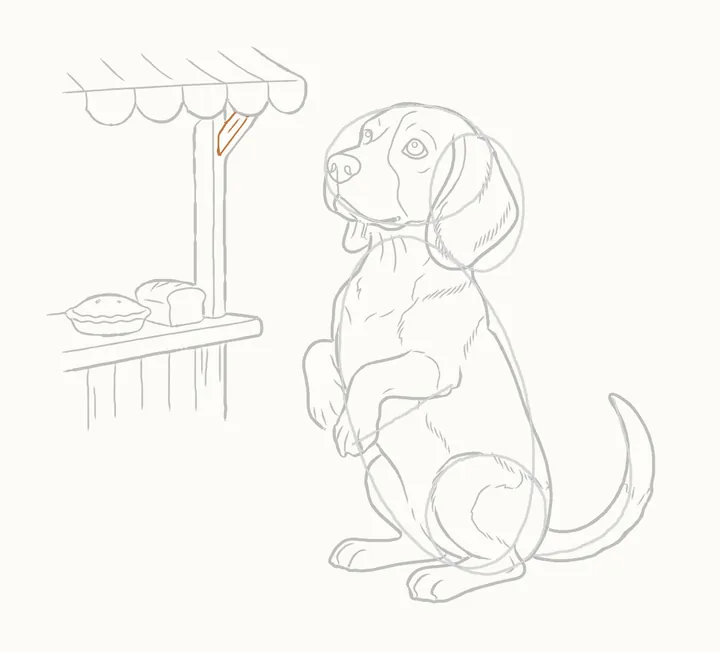
Step 35 of 69
The bracket
At the top of the post, the bracket: a V, down to the post and back up, and a short line inside it.
-
Step 36 of 69
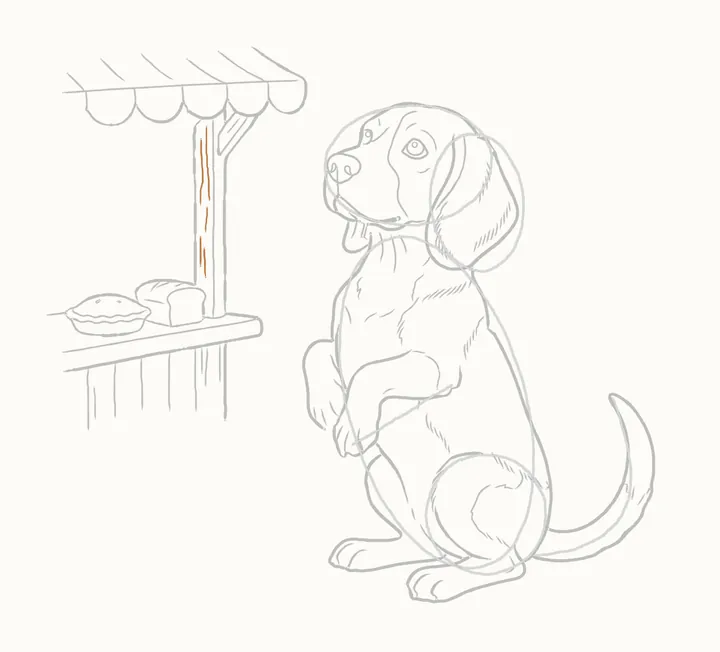
Grain on the post
Grain down the post, each line from its top: two down its left side, then three down its right.
-
Step 37 of 69
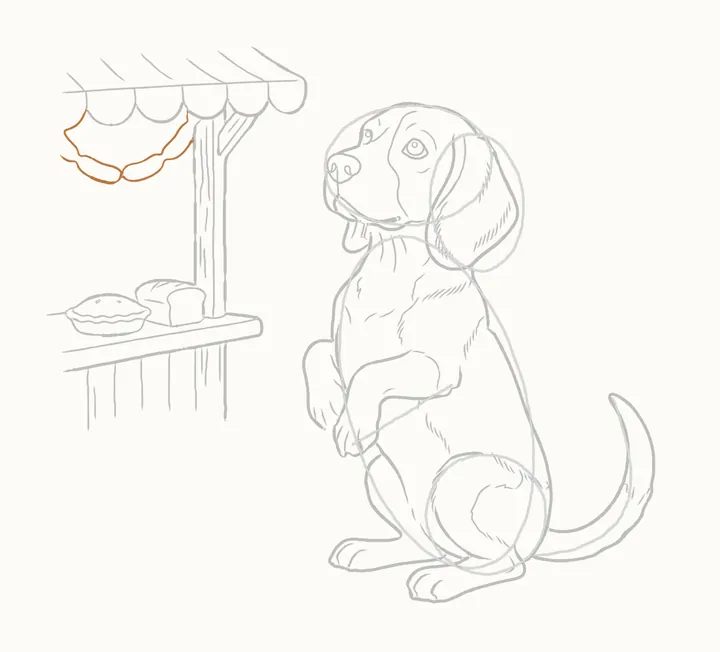
The sausages
Two sausages droop under the flaps: from beside the post, one line over the right one, through the twist and under the left one. Then one from the first flap's tip, back the other way.
-
Step 38 of 69
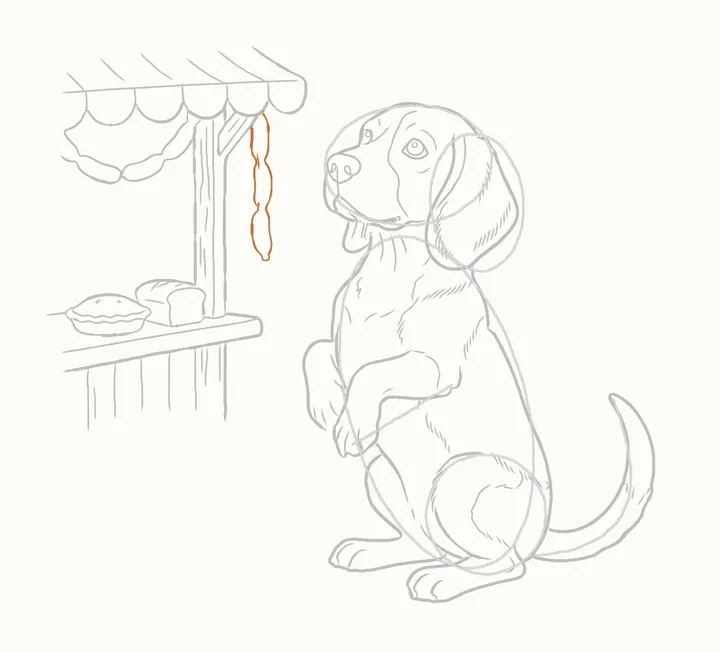
The hanging sausages
From under the bracket, a string of sausages hangs beside the post: one loop down its right side, round the bottom and back up. Then a short line at its top twist.
-
Step 39 of 69
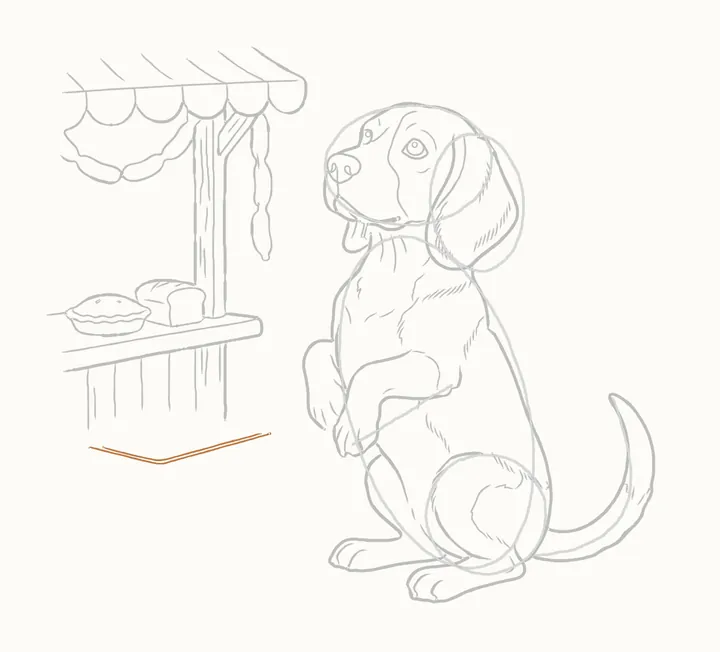
The top of the crate
Below the counter, on the left, a crate of apples: its top edge, from the left corner down a little to the near corner and up off to the right. Then the rim inside it.
-
Step 40 of 69
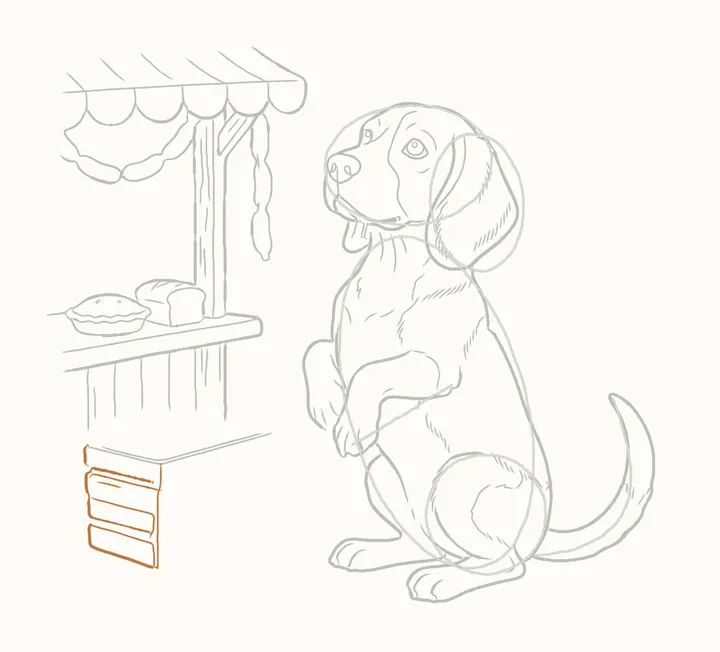
The end of the crate
Its end: round its bottom board, down its corner, the short edge at the top left, then the board lines above, top to bottom; one runs on up its left side.
-
Step 41 of 69
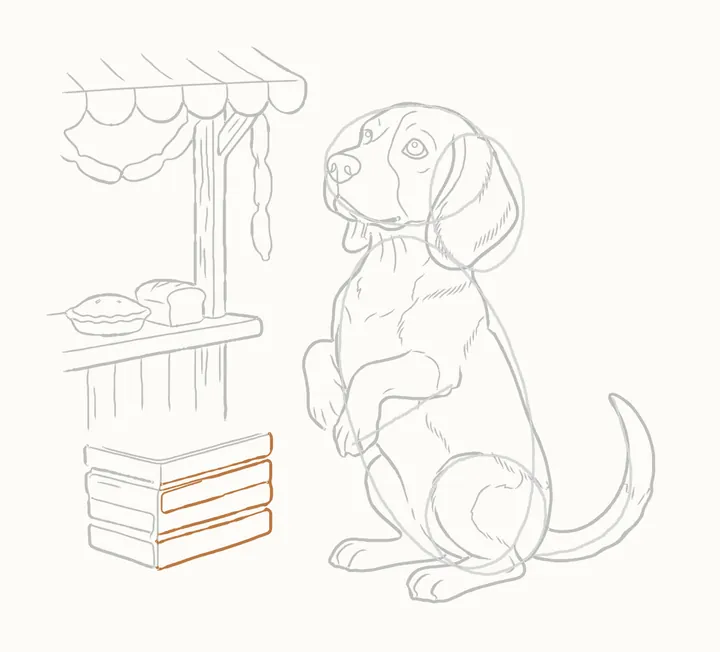
The front of the crate
Then its front, wider, running off to the right: from its top right corner, the lines between its boards, top to bottom.
-
Step 42 of 69
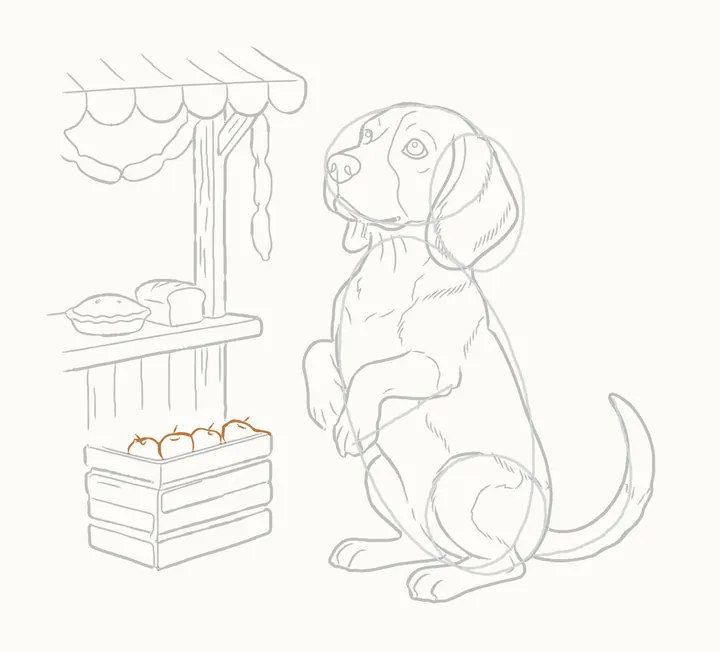
The apples in front
Four apples sit along the crate's top edge. One at a time, left to right: the top of each one's round (the crate hides the rest), then its little dip and stalk.
-
Step 43 of 69
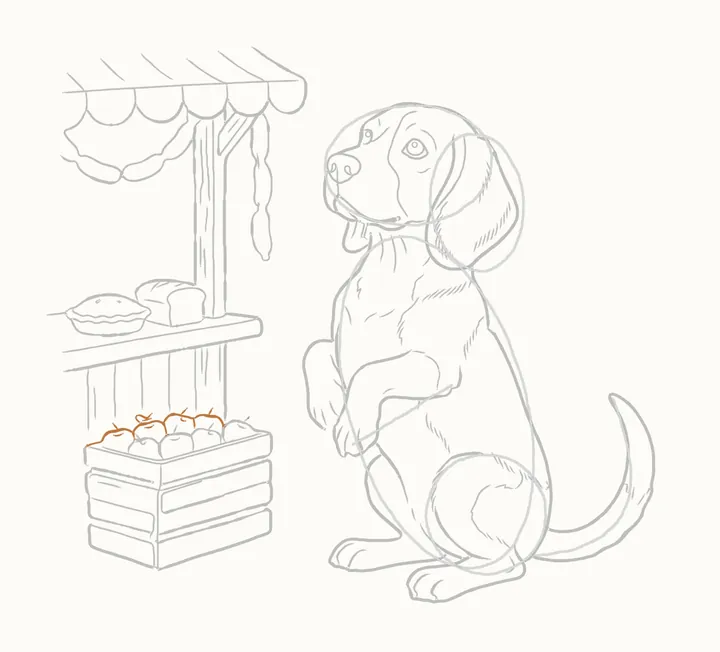
The apples behind
Then four more peeking over them from behind, left to right: each outline, then its dip and stalk. The second has a leaf, and the last shows no dip.
-
Step 44 of 69
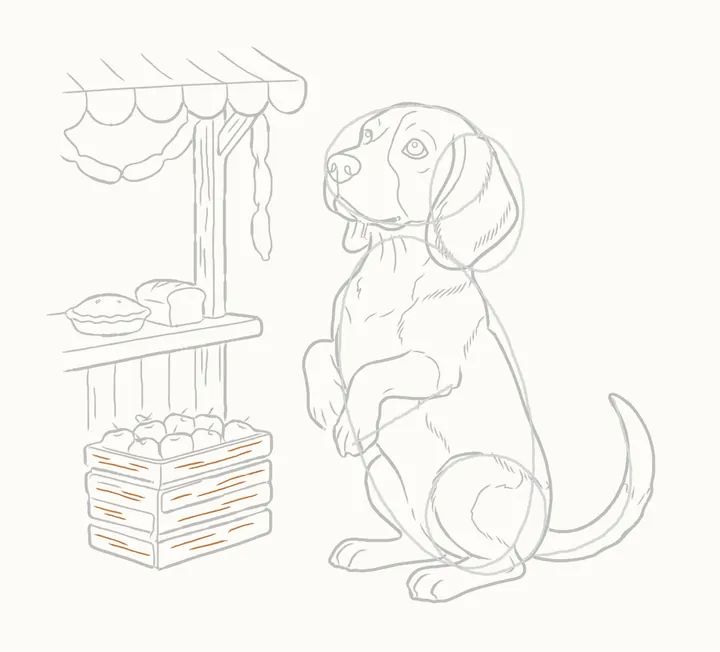
Wood grain
Last on the crate, light grain lines along the boards: nine on the end, top to bottom, then twelve on the front, board by board, left to right.
-
Step 45 of 69
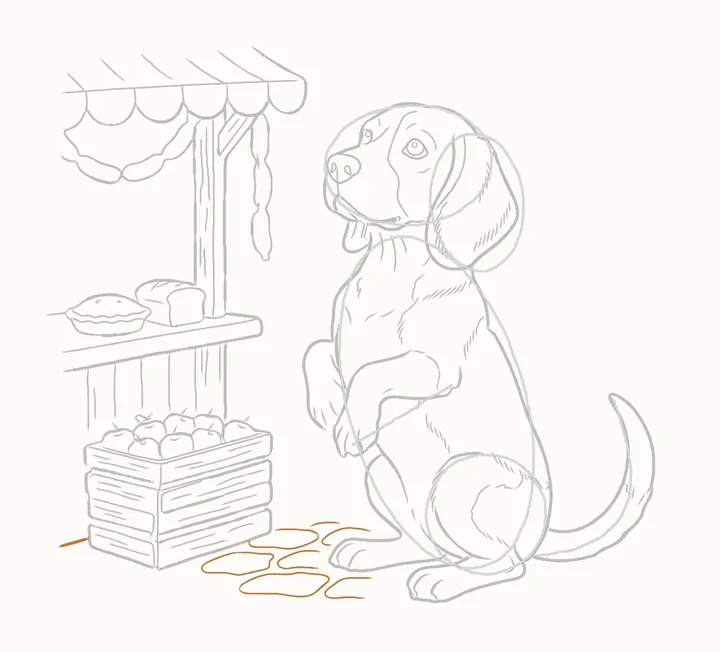
Cobbles by the crate
The cobbles, wobbly rounded shapes: a ground line left of the crate, then the stones between the crate and Biscuit's paws, left to right.
-
Step 46 of 69
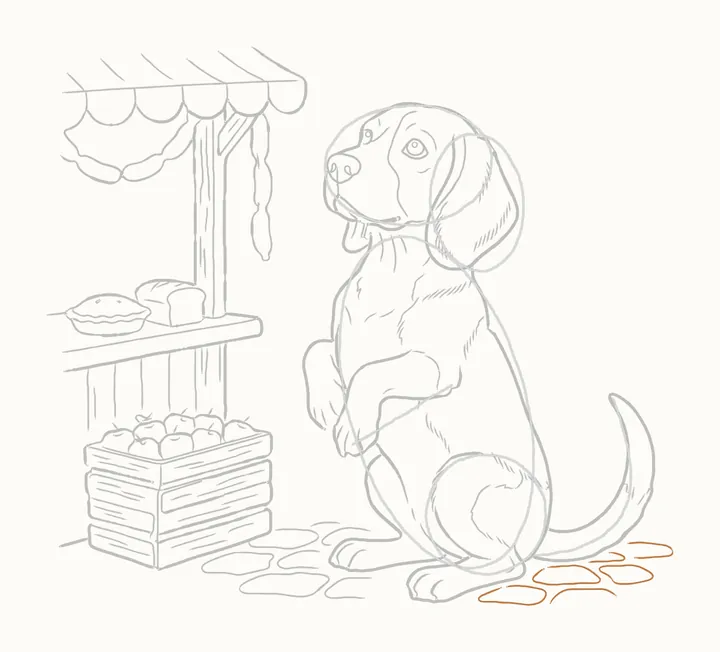
Cobbles round Biscuit
Then the stones under his back feet and round his tail, smaller towards the back.
-
Step 47 of 69
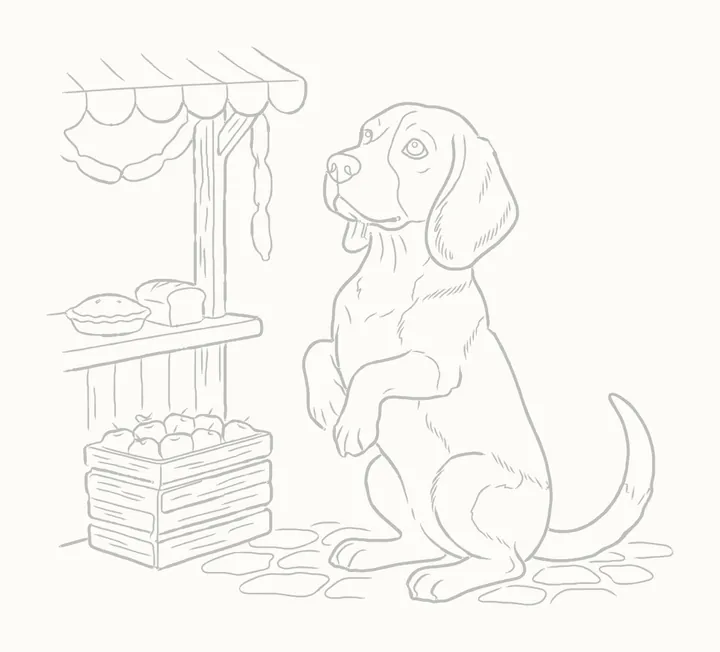
Erase the guides
Rub out the ovals and guide lines. Biscuit and the stall stay.
-
Step 48 of 69
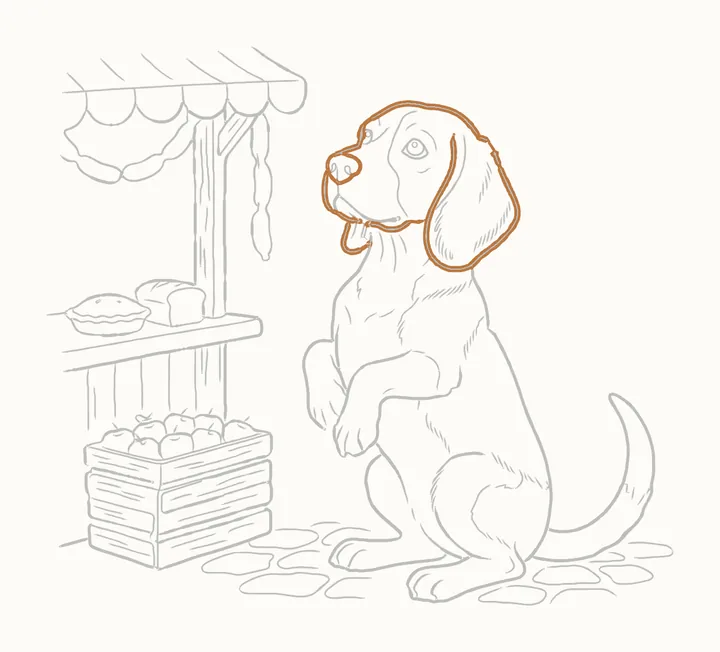
Go over Biscuit's head
Press harder round Biscuit: down the front of his long ear, round it and over his head to the nose. Then down his lip, along his jaw, and round the far ear under his chin.
-
Step 49 of 69
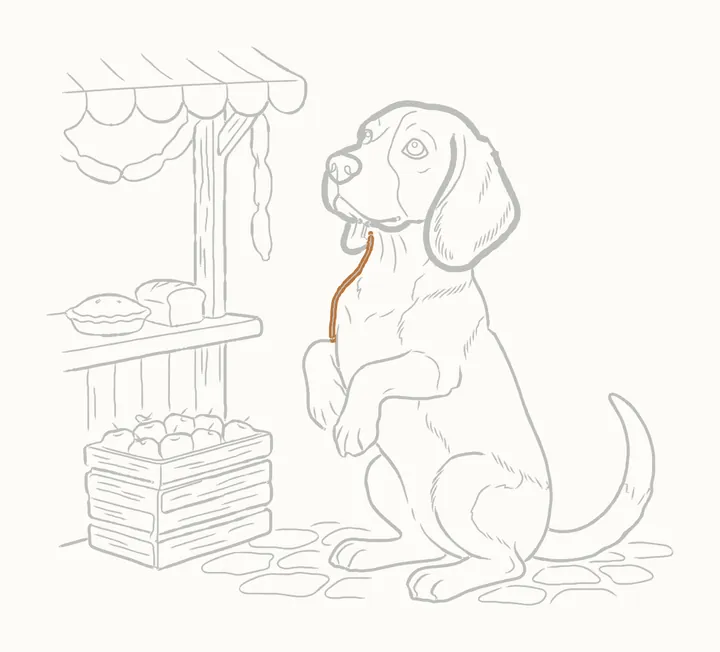
Go over Biscuit's chest
Then down the front of his neck and chest, from under the far ear.
-
Step 50 of 69
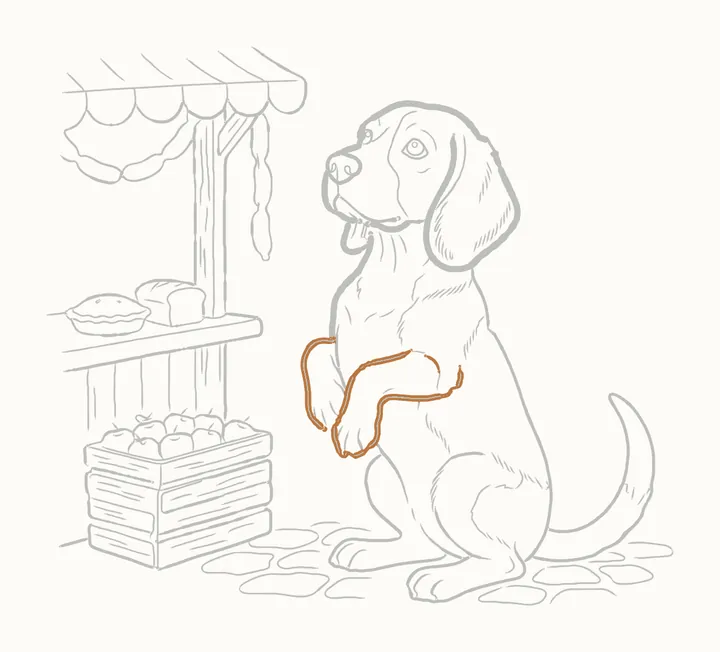
Go over Biscuit's front legs
Round the far front leg from where it meets his chest, then round the front leg he holds up, and the short line at his chest.
-
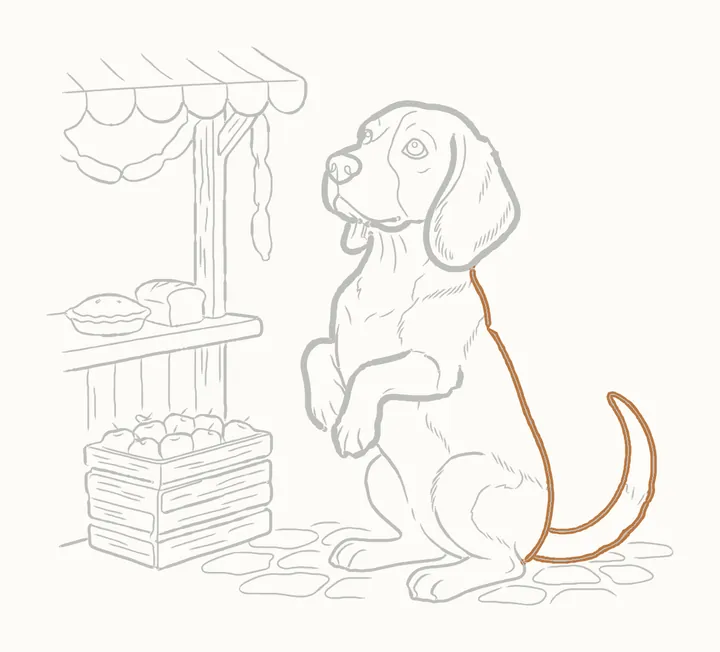
Step 51 of 69
Go over Biscuit's back and tail
Then down his back and round his tail. Leave the stall light, so Biscuit is the boldest thing on the page.
-
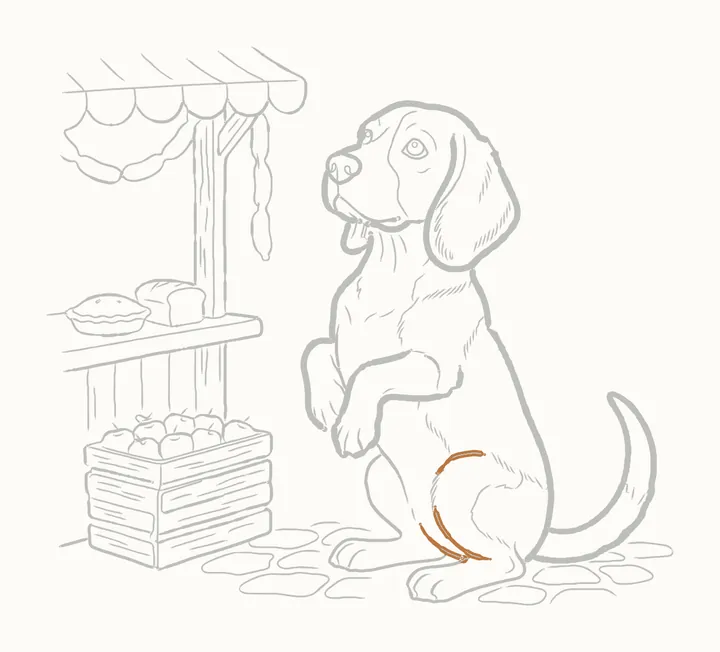
Step 52 of 69
Go over Biscuit's haunch
Then the curve over his haunch, from the left, and the lines of the back leg folded under him.
-
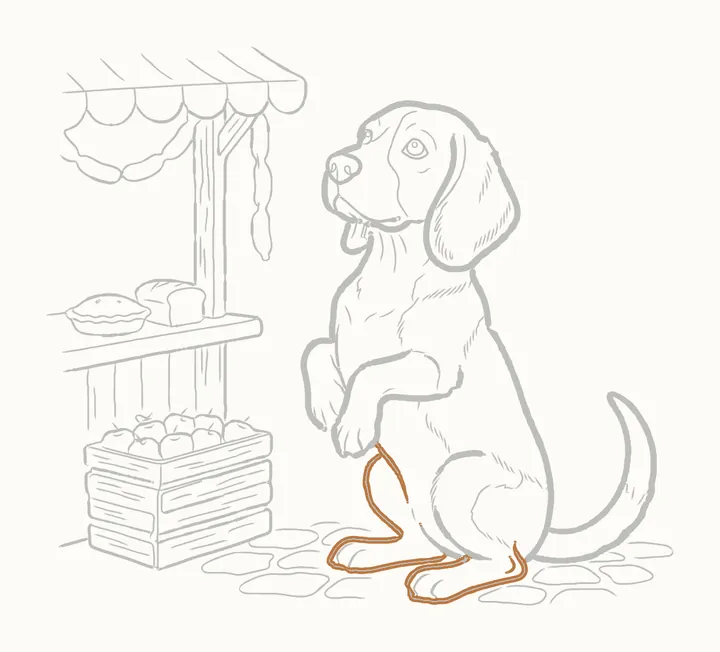
Step 53 of 69
Go over Biscuit's back feet
Last, the back feet: the short line at the near heel and round the near foot, then round the far foot and up to the front paw, and a line back down from under it.
-
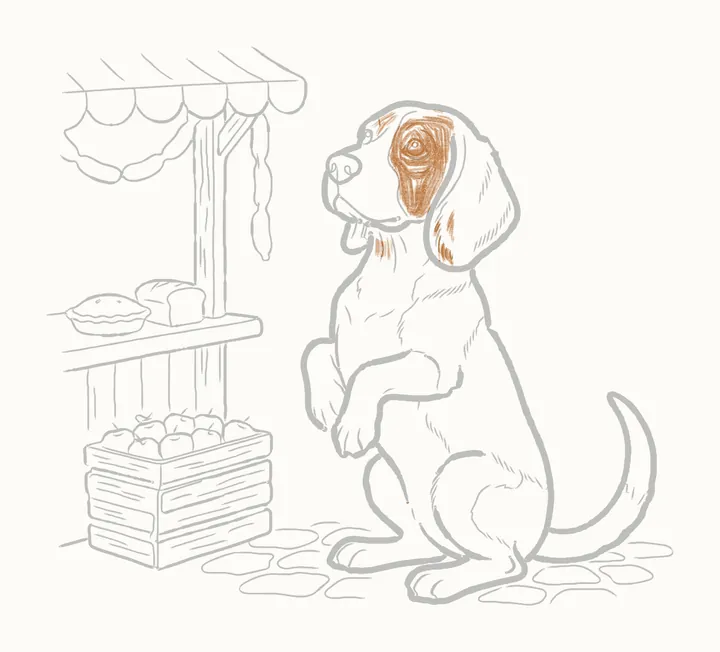
Step 54 of 69
Shading Biscuit's head
Shading now, soft and even. A tone over the dark fur on top of his head and round the eye on the right, keeping his muzzle and the stripe down his face white.
-
Step 55 of 69
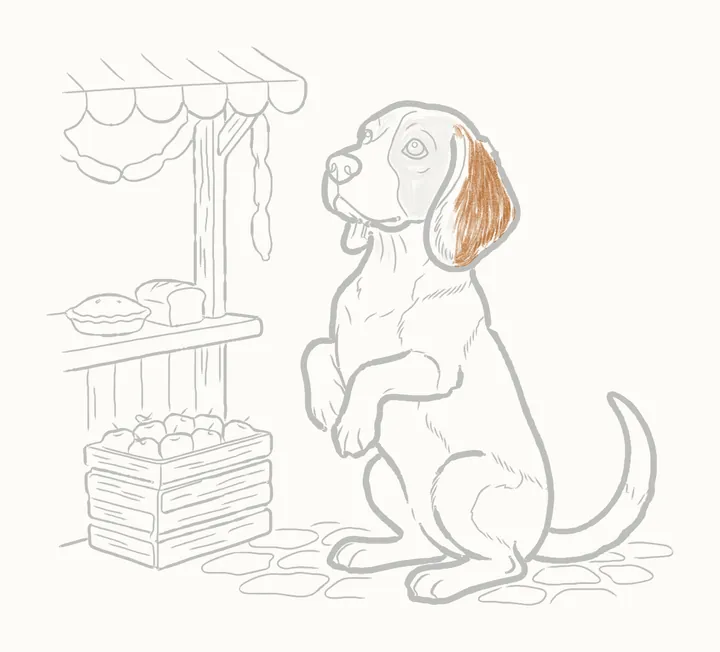
Shading Biscuit's ear
The same soft tone down his long ear. Keep it even, and let the fur strokes show through.
-
Step 56 of 69
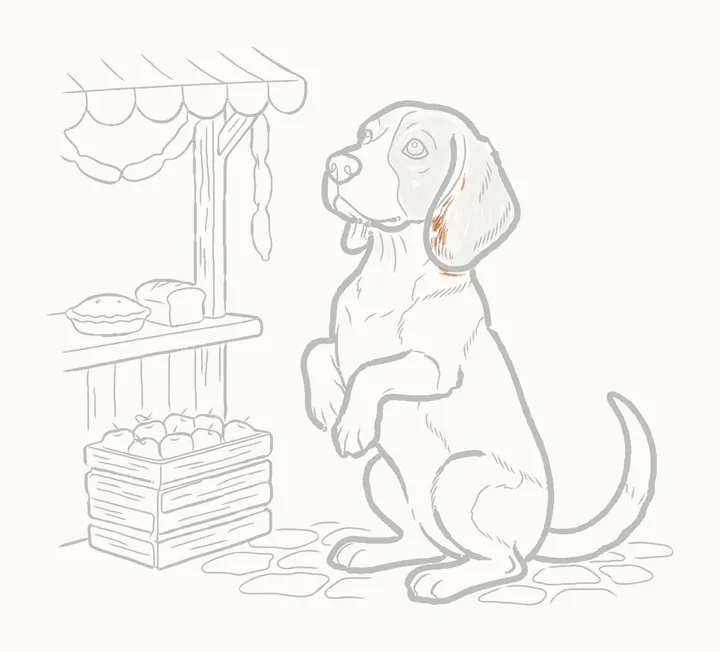
Deep in Biscuit's ear
Press harder along the fold of the ear and in the shadow under it, where it hangs over his neck.
-
Step 57 of 69
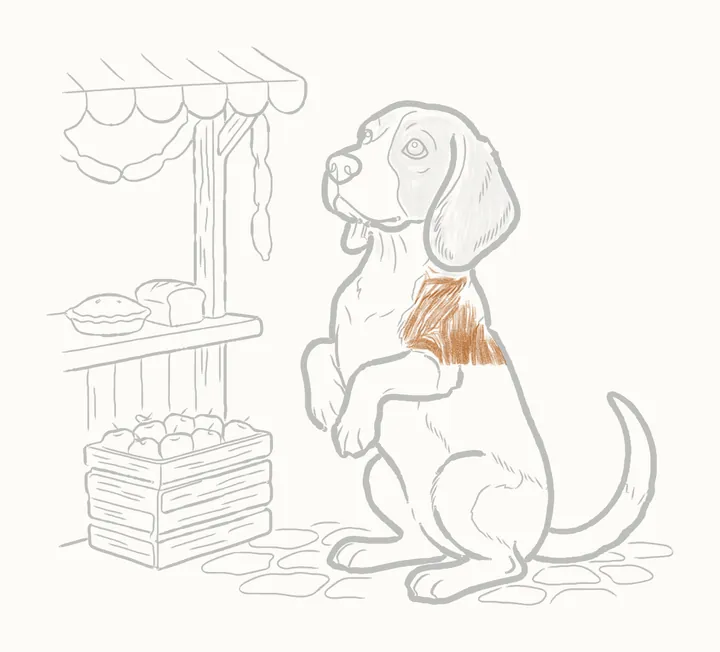
Biscuit's saddle
The same soft tone over the saddle on his back, from his neck down to his shoulder, right up to the soft edge you drew. His white chest stays white.
-
Step 58 of 69
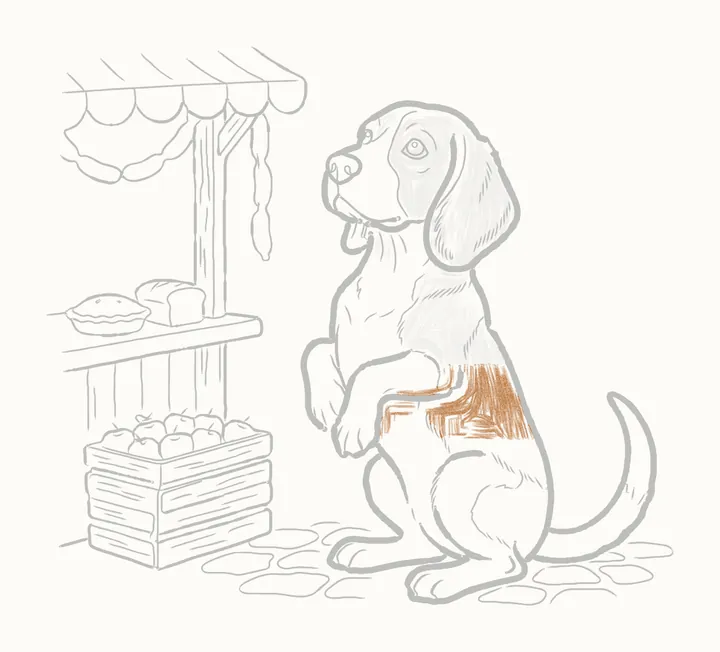
Down Biscuit's side
Carry it on down his side behind the front legs, with a touch in the shadow under the near paw.
-
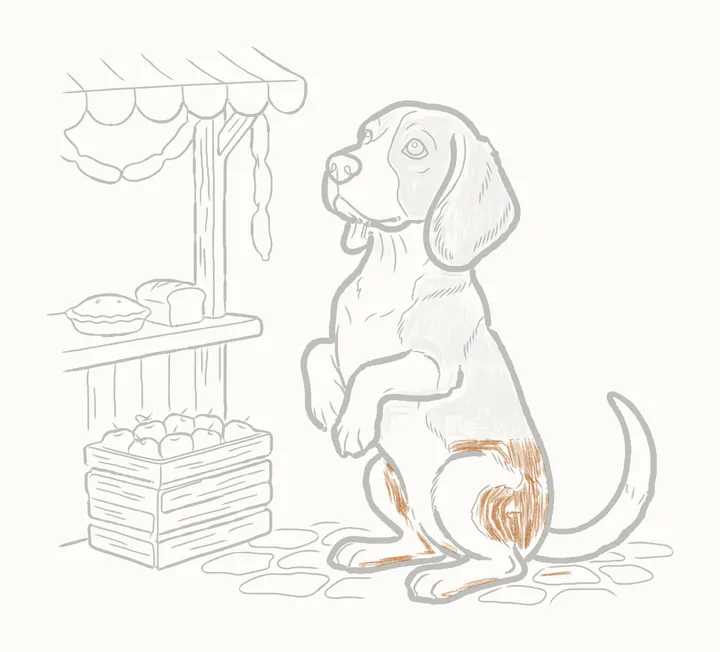
Step 59 of 69
Biscuit's haunch
Then over the patch on his haunch, a little tone between his back legs and under the near back foot.
-
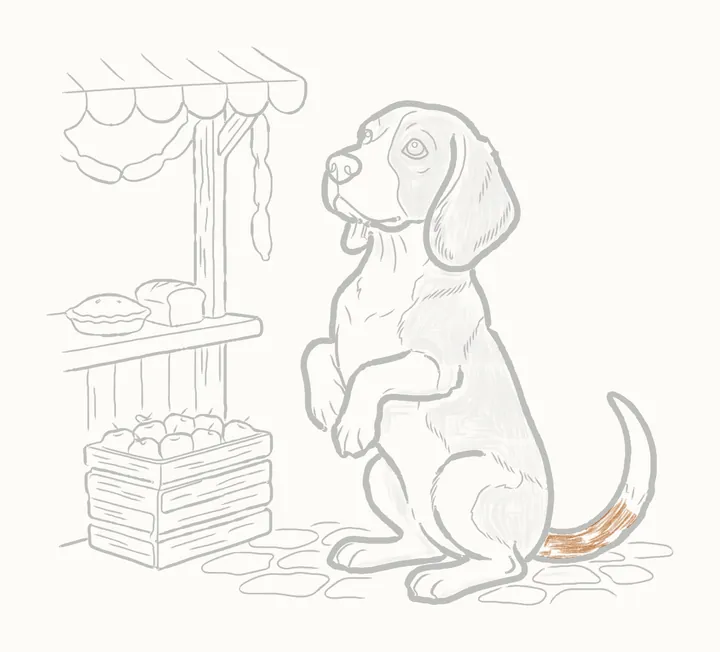
Step 60 of 69
Biscuit's tail
Tone along the tail, leaving the tip white, and a darker strip along its underside.
-
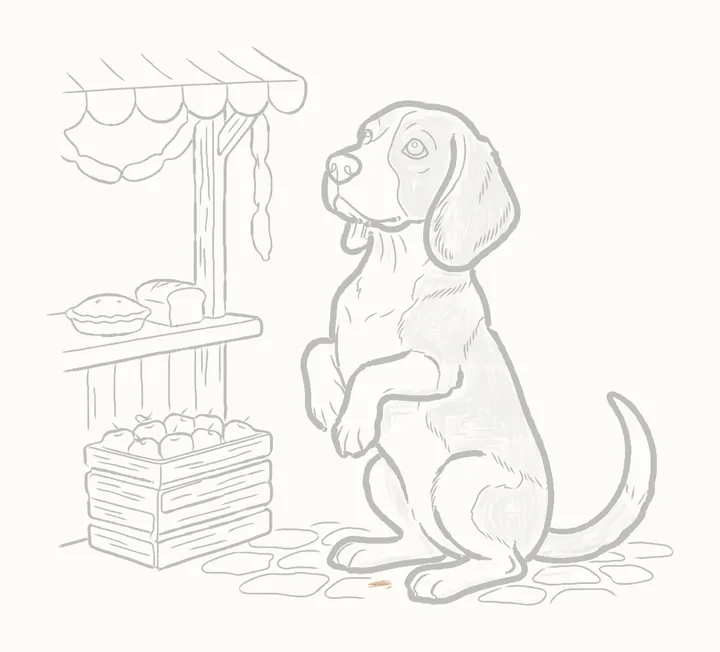
Step 61 of 69
Biscuit's shadow
And a small shadow on the cobbles between his back feet, so he sits on the ground.
-
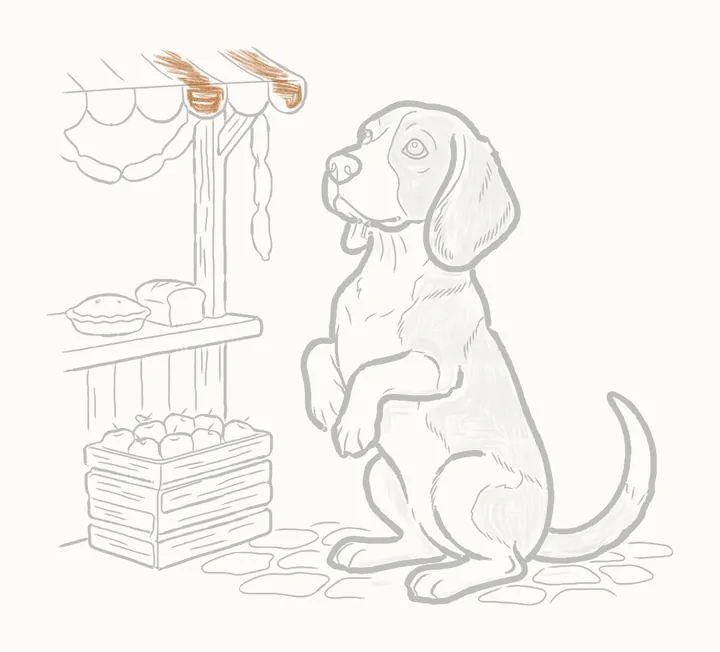
Step 62 of 69
Shading the awning
Now the stall, kept light. A soft tone on every other stripe of the awning.
-
Step 63 of 69
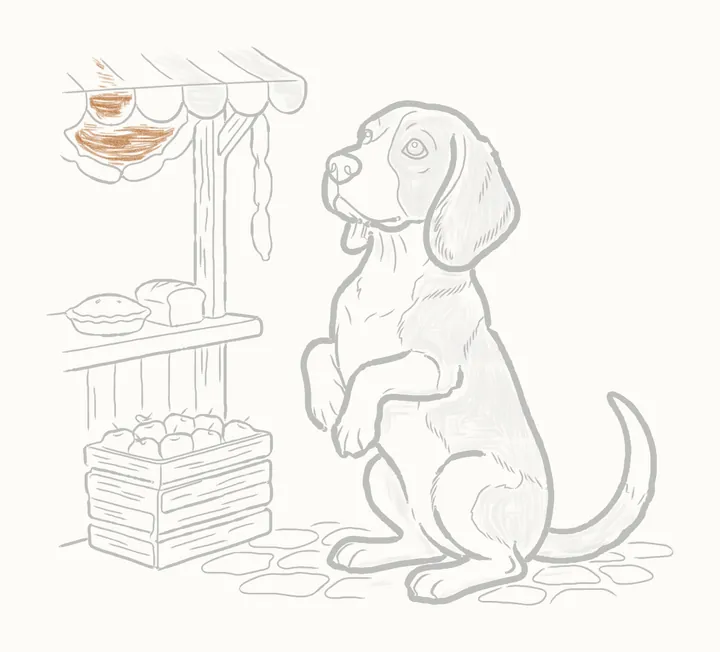
Under the scallops
One more stripe, then tone under the scallops, a little darker in the corner on the left.
-
Step 64 of 69
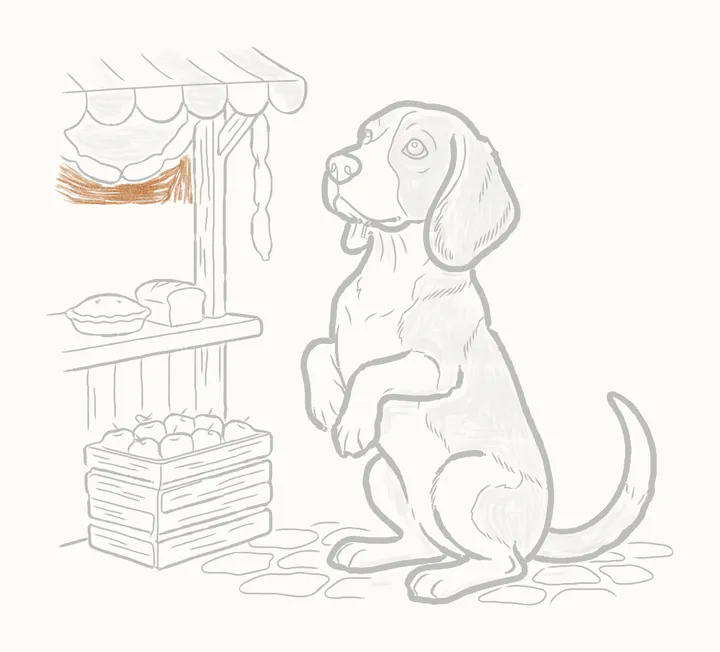
Inside the stall
A light tone on the back of the stall, behind the sausages, so the pale sausages stand out against it.
-
Step 65 of 69
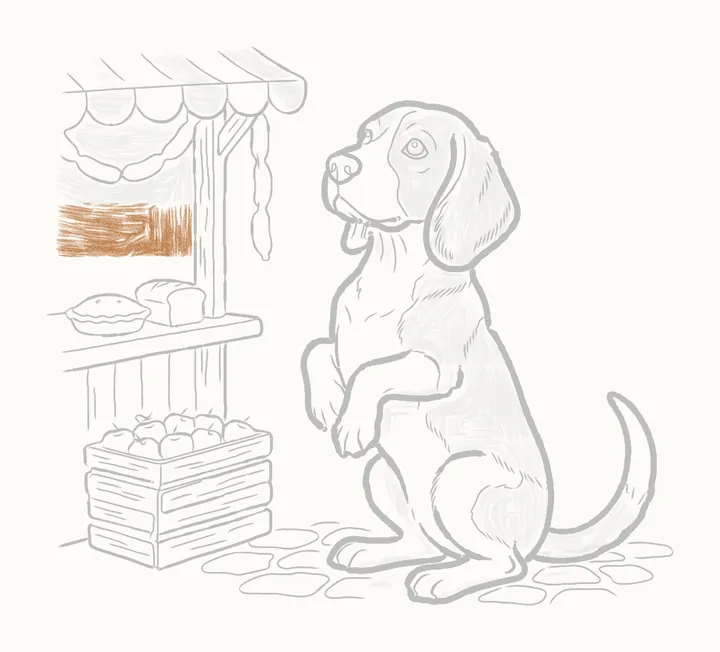
Down the back wall
Carry it on down, keeping it even and light: the stall is only the background.
-
Step 66 of 69
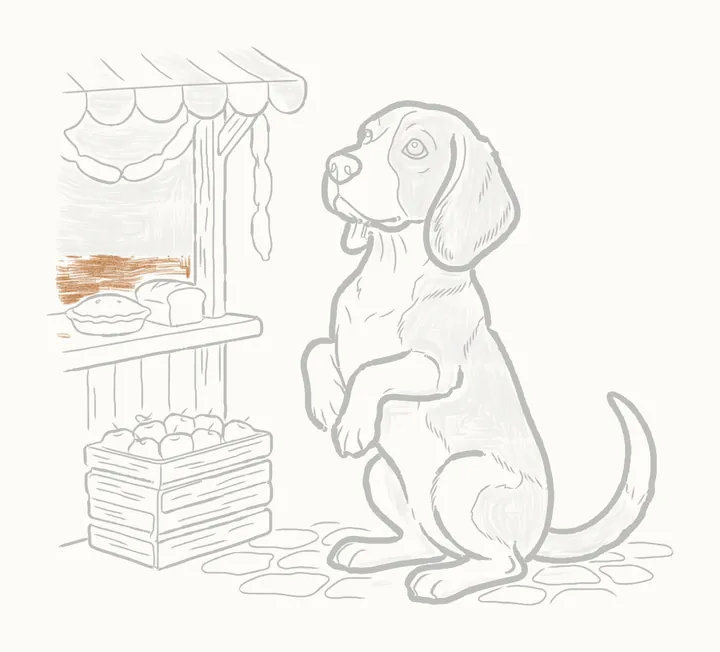
Down to the counter
And on down to the counter, round the pie and the loaf.
-
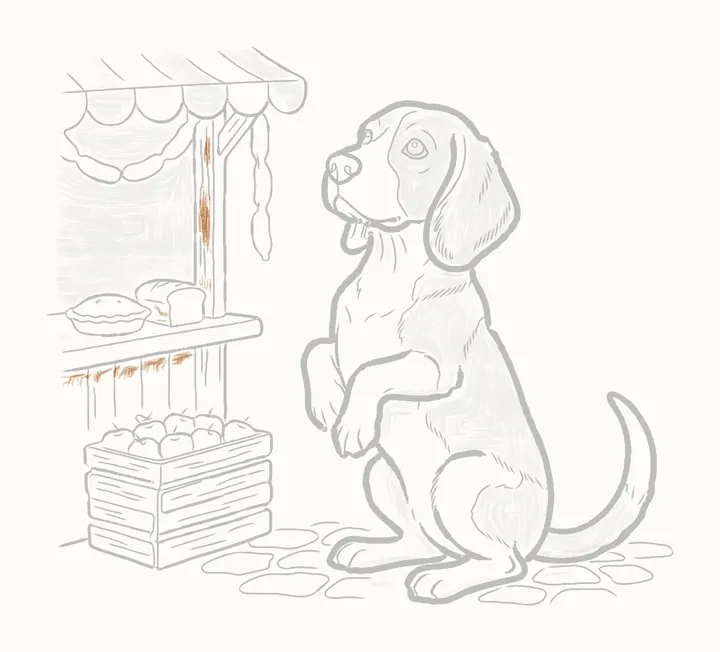
Step 67 of 69
The post and counter
Tone down the shadow side of the post and the loaf, and under the counter's edge.
-
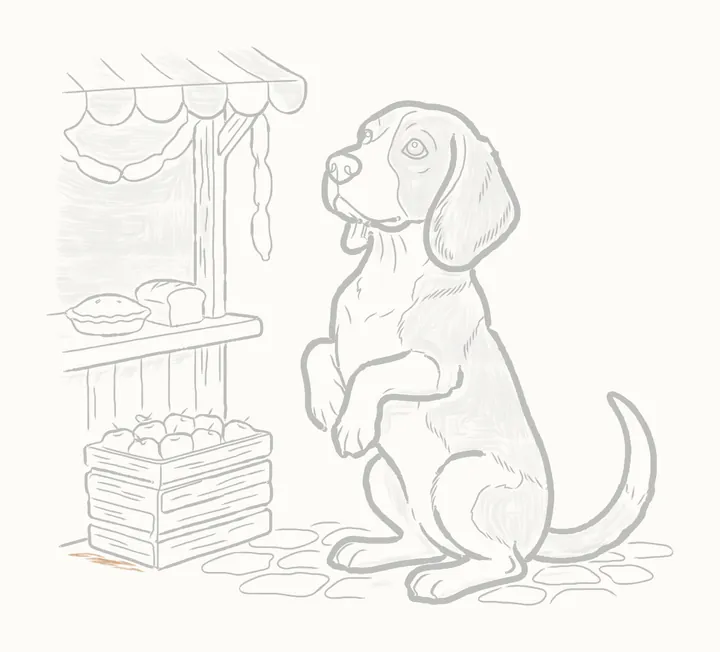
Step 68 of 69
The crate's shadow
Last, a soft shadow on the ground beside the crate.
-
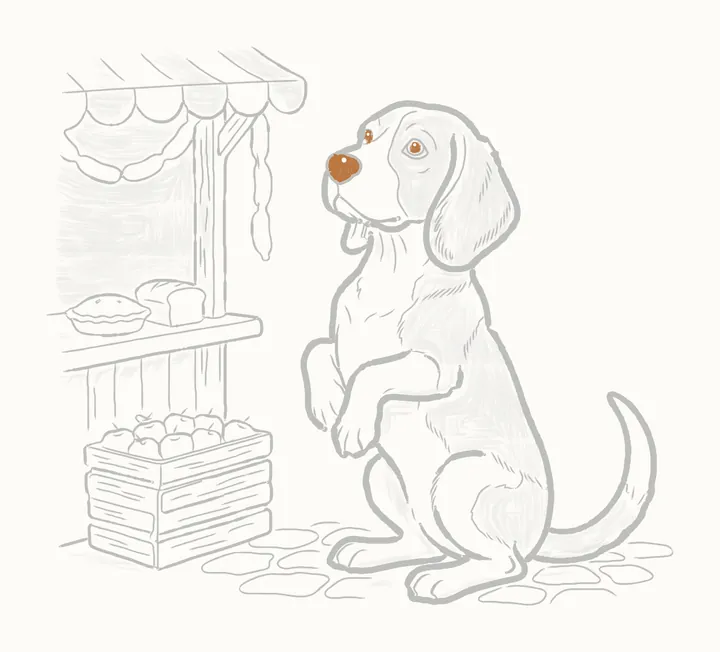
Step 69 of 69
The darks
Last of all, the darks: his black nose, leaving a spot of white at its top, then both pupils, each with its glint. Now he's looking right at the sausages.
-
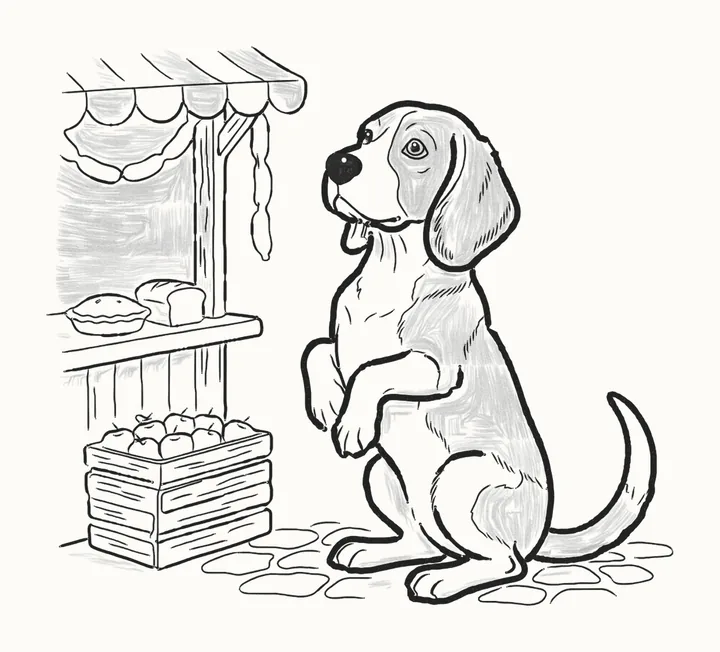
Finished
Your finished beagle begging
That’s Biscuit! Go over any lines you want darker, then sign your drawing in the corner.
In the DrawRabbit app
Biscuit’s world has 9 more drawings
Every animal has a whole world of narrated drawings in DrawRabbit, each one a little story you draw with a real pencil and paper. The first drawing in every world is free.
 Free to start · iPhone and iPad
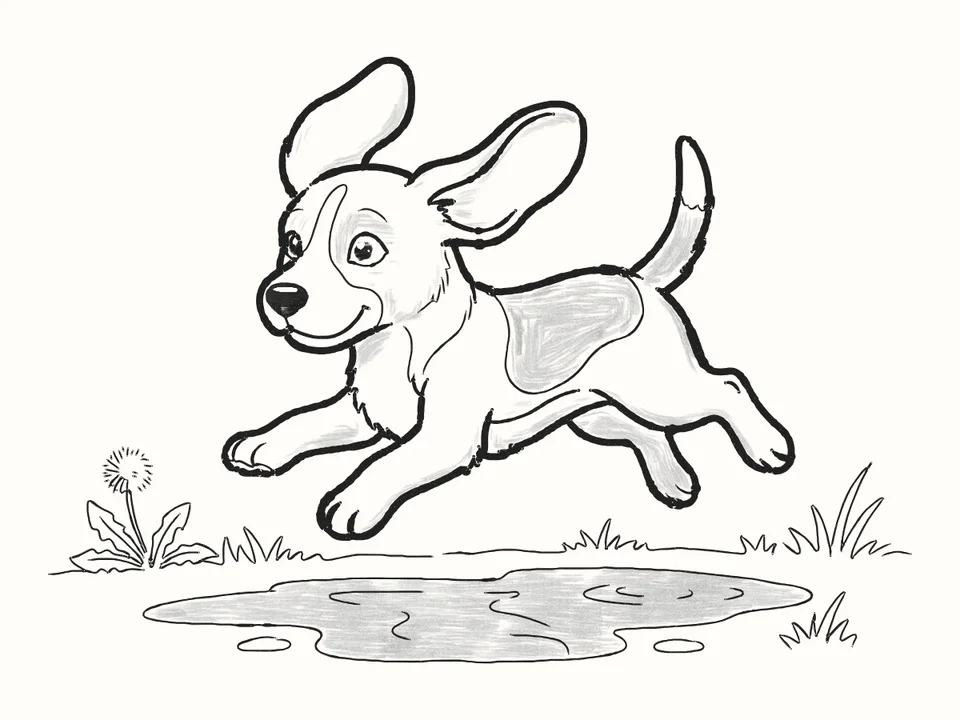 The puddle
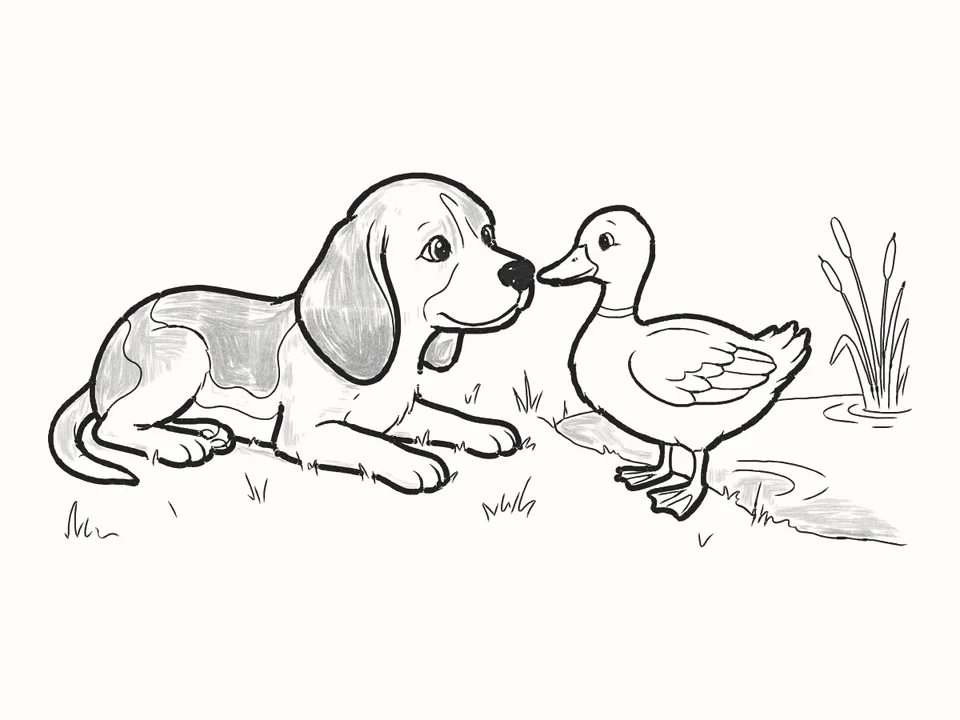 Meeting the ducks
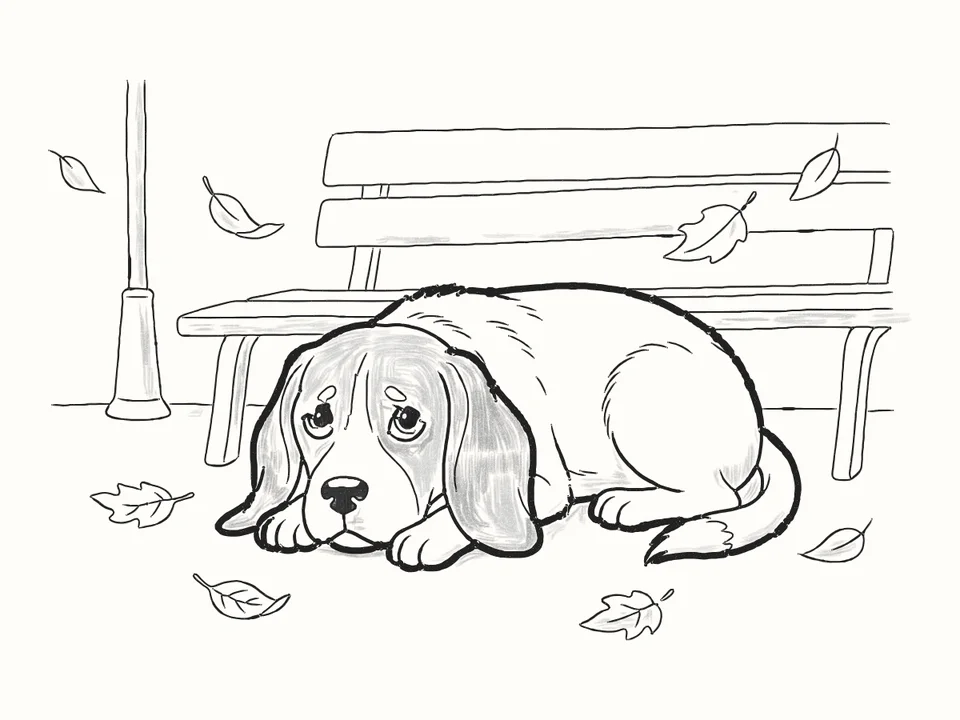 Lost
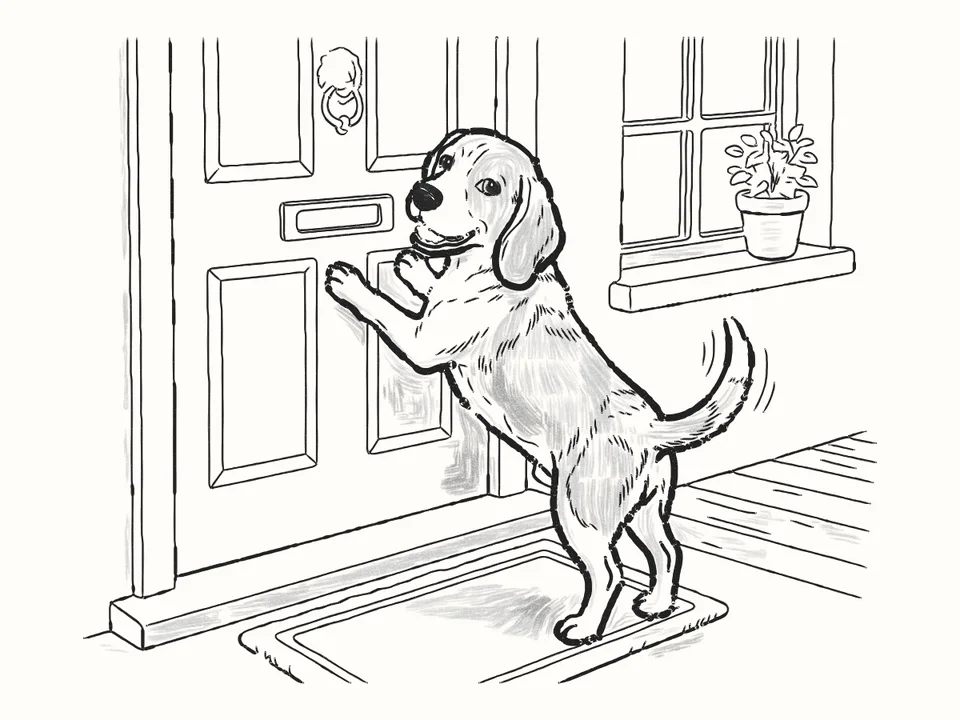 Home at last
Tips for a better beagle begging
Lean the body back
A tall oval leaning back under his head is what sits him up. The circle at its bottom right is the haunch he sits on, and his back feet lie flat on the cobbles.
A soft edge for the saddle
Mark where his brown fur starts with short strokes instead of a line. When you shade up to them later, the patch looks like fur.
Keep the stall light
Only Biscuit gets bold lines. The awning, the counter and the crate stay light, and a light tone on the back of the stall makes the pale sausages stand out.
His nose comes last
The very last step fills in his black nose, leaving a spot of white at its top, then both pupils round their glints. That’s when he looks right at the sausages.
Questions
How do I draw a dog sitting up and begging?
Start with an oval for his head and a tall oval leaning back under it for his body, with a circle at its bottom right for the haunch he sits on. A line from the middle of the body down past its left edge places the leg he holds up, and a curve up from his rump places the tail. Then draw the raised leg, the far front leg peeking out on the left, and his back feet lying flat on the ground.
What do I need?
A pencil, paper and an eraser. Draw the first steps lightly: the guide lines are rubbed out in step 47. The stall needs no guides: it’s placed by Biscuit’s nose, his head and the end of his chest line.
How do I draw a beagle’s markings?
Draw the edge of his brown saddle as a row of short strokes, not a hard line: along from under his long ear, then down just inside his back line, and the same on his haunch. Four short strokes across his tail mark where the brown ends. Near the end, shade the brown parts with an even tone right up to those edges, and keep his chest, his muzzle, the stripe down his face and the tip of his tail white.
Can kids draw it?
Yes. It’s made for beginners of any age. If reading the steps is hard, the draw-along talks you through each line while it draws.
What is DrawRabbit?
A drawing app for iPhone and iPad: narrated, step-by-step lessons you follow with a real pencil and paper. 95 drawings in 10 worlds, free to start, no account needed.